
Episode 58: Kill Phil Volume 2
When Joanna of Castile wed Philip the Handsome aka Habsburg Phil in 1496, few people would have foreseen that this marriage would result in the Habsburg prince wearing the Castilian crown 10 years later. Yet due to a series of dynastic deaths in the Spanish ruling family, by 1501, Joanna was crown princess of Castile. Habsburg Phil’s priorities and attentions began to take on a grander scope as the prospect of ruling in Spain became tantalisingly real. Joanna and Phil would travel to Spain in 1502-3 to be confirmed as heirs to the Castilian crown. Habsburg Phil returned to the Low Countries a year later, but Isabella of Castile insisted Joanna stay behind since she was heavily pregnant. A bizarre incident took place at La Mota castle, after which Joanna rejoined her husband, but Isabella was left doubting her daughter’s capability to rule. Speculation about Joanna’s mental state came to the fore, leading to clashes between her father, Ferdinand of Aragon, and her husband over who would wield the power in Castile. When Isabella of Castile died in 1504, Philip and Joanna made preparations to return to Spain and claim the crown, leaving the Low Countries again in January 1506. This second trip was a disaster from the outset, beginning with an unplanned stay in England following a shipwreck. Then in September, just a few months into his reign as King of Castile, Habsburg Phil would also unexpectedly die, opening the door for his sister, Margaret of Austria, to return to the centre of the political stage and become Regent of the Low Countries.
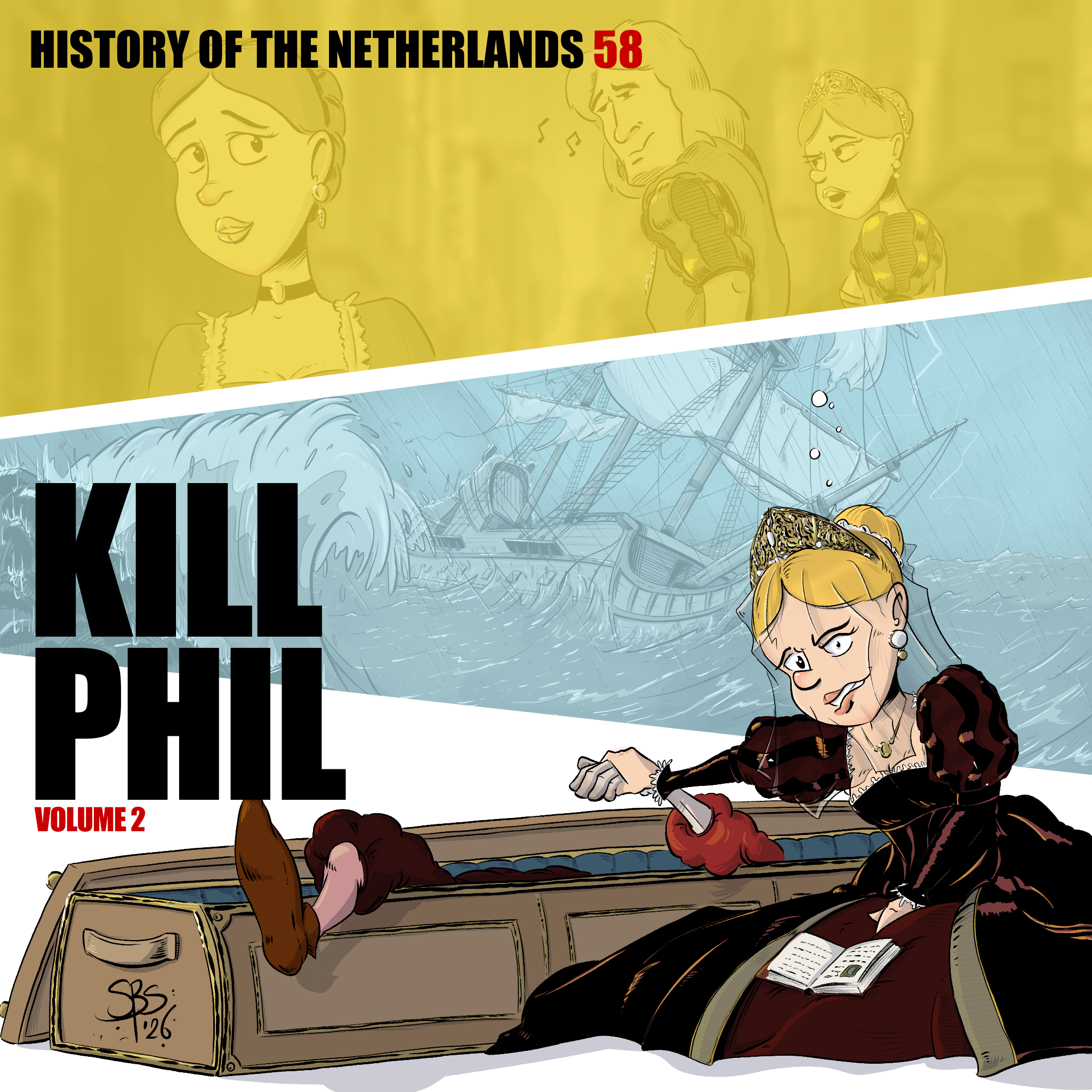
“Kill Phil Volume 2” episode artwork by Steven Straatemans
Who exactly was Joanna of Castile?
In our story so far, we haven’t focused much on the life and experiences of Joanna of Castile. We first discussed her in Episode 49, The Willing Bride, when we were talking about the double marriage between the Habsburgs and the Trastamaras. If you remember, Joanna made the journey from Spain to the Low Countries in the summer of 1496 with a huge fleet of ships. Joanna was, of course, precious cargo. The fact that the marriages between the two dynasties were part of a grand anti-French alliance between Ferdinand of Aragon and Maximilian, meant that they couldn’t take any chances losing her to marauding French pirates. The voyage was horrendous, as the armada was smashed by storms, and when Joanna finally arrived in Arnemuyden in September, 1496, her husband-to-be, Philip, hadn’t even bothered to show up to meet her. We also spoke about Joanna in Episode 54, The Willing Bride, when we mentioned the very-much-wrapped-up-in-folklore story about the birth of her and Philip’s second child, Charles. Joanna had apparently been so jealous of her husband potentially flirting with women at a palace dance that she insisted on attending despite being heavily pregnant. That was probably a bad idea because in the middle of the party she slipped out in labour and then, apocryphally, gave birth to the future emperor on a toilet.
One of the problems with discussing Joanna is that she is a much mythologised figure. Just take a look at the oft repeated epithet that history has left to her, Juana la Loca, Joanna the Mad, and you get a taste of how historians, novelists and the public have viewed her over the centuries. Joanna has been described as insane, jealous, possessive of her husband, depressed, schizophrenic, even as a necrophiliac. In more recent times, she has been re-written as a proto-feminist who refused to submit to the male-determined expectations around her, or as a woman who was not insane at all, but whose so-called feminine traits were exploited by her brother and father for their own political interests. If you want to read a fascinating discussion of the mythologising around her, check out Alexandra Fitts’ article “The Seductive Narrative Appeal of a Madwoman”. In it she writes “there is something both enormously intriguing and repellent about the figure of a woman driven mad by her own “excessive” femininity - her passivity, weakness, love, physical passion, hormonal surges, and desperate need for affection. And while concepts of madness may have evolved, the public is loath to move on from the very aspects of [Joanna] that have made her legend captivating”. People have been projecting their own society’s thoughts and expectations about women onto the image of Joanna ever since she lived, making it hard to untangle the myth from the reality. We will try our best to keep this podcast as factual as possible when discussing Joanna but we will no doubt have to include some of the more popular tropes of her life since they are, quite simply, compelling stories.
Let’s go back to the very beginning of her life. Joanna was born on November 6, 1479, the third child of Isabella of Castile and Ferdinand of Aragon Her illustrious parents had already had a daughter, Isabella, and a son, Juan. Upon her birth, there would have been very low expectation that baby Johanna would ever come to rule their kingdoms herself. As with all children of the nobility in Europe at this time, Joanna’s lot would be to get married off to further her family’s influence and ambitions across the continent. She was apparently a bright child who had a knack for music, dance and languages, becoming fluent in Latin and French as well as, of course, Spanish. Her mother, Isabella of Castile, is still today renowned for her patronage of the arts and she ensured that all of her children, including her daughters, received a well-rounded, humanist education. So this was the young woman who was shipped off towards Flanders in the summer of 1496 to marry Philip the Handsome. There is no mention of instability in the sources and, when she set sail, nobody in Spain probably ever expected to see her again.
Joanna’s first stint in the Low Countries
Joanna’s first few months in the Low Countries were difficult in a myriad of ways. The bad weather which hit the fleet had caused a few ships to run aground on the Flemish sandbanks. A bunch of freight was lost, including a lot of Joanna’s personal belongs, as well as those of the courtiers she was bringing along for the ride. And speaking of freight, here is a super early edition of your favourite segment of the podcast, Bet You Didn’t Know That Was Dutch! The English word freight, comes from the Middle Dutch word vrecht or vracht, meaning to “hire a ship for transporting goods”. Apparently this word is really closely related to the word fraught, which originally meant “to load with cargo”. So that’s actually two English words coming from the same Dutch origin! Freight! Fraught! Bet you didn’t know they were Dutch. Back to the shores of Zeeland. The Spanish sailors and nobles who had accompanied Joanna were unhappy with how cold it was in the Low Countries in October and complained bitterly about it. In Episode 49 we mentioned how there were reports that thousands of the Spanish sailors died from an outbreak of some disease, speculated to be syphilis, whilst they were waiting to make the return leg of the voyage back to Spain with Margaret of Austria.
In his article about Joanna’s first stint in the Netherlands, historian Raymond Fagel suggests that perhaps one of the reasons why Habsburg Phil didn’t meet Joanna upon her arrival in Zeeland was because his own court did not favour the match between the two. The Burgundian nobility that surrounded Philip were very much inclined towards keeping good relationships with France. This marriage, which in its very essence was part of an anti-France alliance between Ferdinand of Aragon and Maximilian, represented a threat to their interests. Phillip’s absence can hardly be looked at as anything but a political move but, as we have seen on countless occasions, his position on matters was very influenced by the opinions of others, which must be taken into account when trying to understand his motives. Only a few nobles actually bothered to meet Joanna in Zeeland and one was, in fact, a Spanish woman, doña Marina Manuel, the wife of one of Philip the Good’s many bastard children, Baldwin of Burgundy. Fagel writes “maybe already at that point the young princess started to understand that she and her followers were considered by some as an unwelcome rival court.” So Joanna and her Spanish companions were facing a frosty reception in more ways than one. It is worth mentioning here that, according to historian Glyn Redworth in the article ‘Excluded by men? Joanna the Mad, patriarchy and a charge of insanity’, Maximilian found a solution to the negativity surrounding Philip’s failure to greet his soon-to-be wife. The emperor commissioned an illustrated book, which “contains a wholly fictitious engraving showing the Archduke Philip almost wading into the sea to greet his bride at Middelburg.” This is very typical of Maximilian, rewriting the history books to make himself and his family look better in hindsight.
The lead up to Joanna and Habsburg Phil’s wedding is described in great detail in the chronicle of our old mate Molinet, who emphasises the, for want of a better way of putting it, Spanish-ness of the bride and her band of followers. Molinet writes that Joanna was “of fine bearing and graceful, the most richly adorned bearing ever seen in the lands of my lord the archduke…mounted on a mule in the Spanish style, her head uncovered and was accompanied by sixteen noble ladies and a matron who, dressed in cloth of gold, followed her mounted in the same manner; there were pageants dressed in rich finery and twenty-eight or thirty buglers who did their best at this entrance to rouse the good cheers”. I’m not exactly sure what being mounted on a mule Spanish style means… did they rock up half an hour late? Regardless, given everything we’ve seen already in this podcast about Burgundian fashions, ceremony and pompousness, the fact that Joanna was dressed in a way that outshone anything ever seen there before says a lot.
Molinet emphasises the foreign nature of the Spanish again later when he writes about Margaret of Austria meeting Joanna, who was sick in bed, before the wedding. “She entered and found her sister-in-law laying ill on a basset and flat bed, without a cover, in the Spanish style… the room was so richly hung with cloth of gold in the new fashion that the like had never ben seen before… never was such wealth seen, never was such treasure seen, nor ever was such nobility seen… the princes, ecclesiastics, and nobles were very richly and pompously dressed in robes of gold and chains, the unparalleled in the world, and fine jewels of inestimable value. But their retinues were rather thinly dressed and did not incur great expenses compared to [those of these lands], for they were frugal in eating and drinking.” So Joanna apparently lay in bed in a very Spanish way, the Spanish outdressed the Burgundians, but the Burgundians out-drank and out-ate the Spanish. After the initial delay, Philip and Joanna finally met each other the day before their official wedding, which took place at Lier on October 20, 1496. After the wedding, Joanna was paraded around Brabant to meet her new subjects, whilst Habsburg Phil accompanied his sister to go and send her off to Spain. The couple then made entries into the major cities of Ghent, Bruges and Brussels in early 1497.
The relationship between Joanna and Habsburg Phil
As mentioned earlier, it is really difficult to understand the true nature of the relationship between Joanna and Philip, but historian Raymond Fagel has helped immensely by reconstructing the first stint of their life together in the Low Countries. Between their wedding and their first journey to Spain together, the period from 1496-1501, Joanna spent over 55% of her time at the Coudenberg palace in Brussels. During this time, Joanna and Philip had three children together, meaning that she was pregnant for over 60% of it. As crass as it is to say today, the primary expectation of noble women in this era was to reproduce (preferably by making boys) and thus continue on the royal bloodlines. Historian Glyn Redworth writes of this “In a patriarchal world, her repeated pregnancies were regarded as a sign that she was fundamentally healthy in body and in mind”. In total, Joanna and Philip would have six children, two boys and four girls, all of whom survived infanthood and all of whom remarkably would go on to become either emperors or queens. Again, according to Fagel, records show that Joanna insisted on spending most of her time with her children personally, rather than leaving the business of raising and taking care of them in the hands of others. By the standards of the time, the people around Joanna must have thought she was fulfilling her familial duty admirably.
Apart from the business of reproduction, however, Joanna’s life at the court in Brussels seems to have been stymied and stifled by Habsburg Phil and his courtiers. Philip appears to have ensured that Joanna was financially dependent on him alone. According to the details of their marriage contract, Joanna was to receive payments each year to be able to pay for her own retinue, but Philip never gave her what was promised. As such, many of the Spanish noblemen and women who had accompanied her to Flanders had to leave because they couldn’t afford to live there anymore. According to historian Bethany Aram, about 80% of the retinue who had arrived with Joanna departed within 6 months of their arrival. Of course, when they left, Philip replaced them with people of his own choosing. Isabella of Castile was apparently so concerned about this situation that she sent a man called Pedro Ruiz de la Mota to make sure that Joanna received the money that she was entitled to, but this was to no avail.
We can get an insight into Joanna’s perspective on the running of her household from the correspondence of the Spanish ambassador Fuensalida. In a letter to the Spanish monarchs dated August 6, 1500, Fuensalida writes of a meeting he had with Joanna to “see what path could be taken so that Her Excellency might have a greater part in the governance of her estate and house than she had had until now”. Joanna told Fuensalida that she was unable to take control of her own expenses because of “a very great impediment to this being done” in the form of Philip’s most trusted advisor, Frans van Busleyden, the archbishop of Besançon. Joanna explained to Fuensalida that Habsburg Phil was responsive to her concerns when they were alone because “she knows that he loves her”, but that she could never tell him her honest opinions because Philip would then go and repeat everything to Busleyden. As such, Joanna was forced into silence. Later on, Fuensalida wrote to Spain that another of Philip’s councillors had determined that “none of those who lived with the Princess should speak the Castilian language, and that if they did, they should consider themselves dismissed”. It seems as though it was a deliberate effort by the court to cut Joanna off from her homeland and to minimise any Spanish influence within it. It is fair to say that this would have been a difficult situation for anybody, being so far from home, almost perpetually pregnant, raising children, financially dependent on your husband, unable to speak your native language and having nobody with whom you can confide.
Becoming crown princess of Castile
As we have covered in this podcast, a series of unexpected deaths led to Joanna becoming the presumptive heir to her parents. Nobody could have expected her brother, Juan’s, demise would be shortly followed by that of her sister, Isabella and, then, Isabella’s infant son. When the route to kingship in Spain began to reveal itself before Habsburg Phil, it created a whole new scope of possibility for him. Joanna’s mother, Queen Isabella, was apparently anxious for Joanna to return to Spain so that oaths could be taken and she could get as much education from her mother on how to run a kingdom as was possible. There does not, at this stage around 1501, appear to have been any suggestion from her mother that Joanna’s ability, temperament or mindset were vulnerabilities. The bishop of Cordoba reported that she was “very sensible and well balanced” while the Spanish ambassador wrote “I do not believe anyone has seen such good sense in one so young”.
After becoming the crown princess, Joanna wanted to sail directly for Spain to get the oaths that would secure her future rule. Habsburg Phil, however, dallied. For historians studying these events they can, as is often the case in this period, rely on old Molinet for an account of the princely couple’s travel through France. However, there also exists writings from amongst their entourage, notably those of one of Philip’s chamberlains; a young nobleman called Anton de Lalaing. He is going to be around in a significant capacity for the next four decades, so get familiar with his name. In his later published work "memoryéz par escript,", he gives us an idea of how much urgency Philip was taking to this task.
“We left Brussels on November 4th. There was no hurry. We lingered for four days in Mons and the surrounding region before reaching Valenciennes and thus we only left Hainaut, and therefore the Netherlands, on the tenth day of the journey. It is true that for [Joanna], the passage through the two main cities of the Hainaut county was a first entry, an inauguration, while Philip had already been there in…1495. On the way to Paris, Blois and then the Pyrenees, the sovereign of the Netherlands was received as if he were the King of France himself.”
The Archduke’s decision to travel languidly through France, rather than quickly by sea, would allow him to pay homage to the French King along the way. Habsburg Phil did this in his capacity as the Count of Flanders and Artois, and would be favoured by having a few more towns in the regions added to his collection. This pandering to Louis XII was not super considerate towards Joanna, whose role and purpose in their marriage was based primarily on it being an antagonistic diplomatic move against the French monarch. During the visit, there were a few terse moments which might have inflamed tensions, such as when she was became her turn to genuflect at the French King’s feet after her husband had already done so; the French king protected her dignity and intervened. Or when, during mass, she was asked to distribute alms on behalf of the French queen. As the future queen of Spain, it was unacceptable that Joanna might show such deference to the French royals. She managed to avoid any such event, showing that she was switched on to the do’s and dont’s that came tethered to her particular station in life.
We won’t go as slowly on their journey as they did. Having left in early November, they did not cross into Spain until towards the end of January, 1502. Month after month of travel and reception by towns and cities followed, including services whereby Habsburg Phil had to acknowledge and respect the privileges of a town. In April they were due to meet Ferdinand and Isabella, but a case of Habsburg Phil contracting the measles kept it from taking place. Finally recovered from his illness, he and Joanna arrived in Toledo on May 7, him to meet his in-laws and her to see her parents for the first time in six years. After around 2 weeks of, as historian Jean-Marie Cauchies puts it, “religious ceremonies and diplomatic activities”, which sounds absolutely tedious, the Cortes of Castile, the equivalent of the State-General there, recognised Joanna as the heir to the Castilian throne. Philip was designated as her consort. Cauchies writes “the members of the assembly did not…express any direct objections regarding the notorious instability of their future queen and her real abilities to govern”. Is it possible that there were no objections because the supposed instability of Joanna was not, after all, so notorious? At least at this point? Whatever the answer to that, in the second half of this episode we will explore how from this point onwards, things for Joanna were going to take an awful turn for the worst. And speaking of the worst things, here’s some ads. See you on the other side.
Joanna and Philip take their first trip to Spain
So with Joanna of Castile and Habsburg Phil now officially recognised as heirs to the throne of Castile, the next logical step was to go and do the same in Aragon. After about four months in Toledo, where the couple received oaths and met with high dignitaries, Philip and Joanna turned their entourage north. At this stage Frans van Busleyden, the confidante of Habsburg Phil who caused Joanna so much distrust, perished at a monastery near Toledo after a brief illness. Following this, the trek north continued, not necessarily at a blistering pace although some Spanish contemporaries saw them as being in a hurry, with the couple arriving in Zaragoza half way through October, 1502. On October 27, the Cortes of Aragon met in a cathedral in Zaragoza where, in the presence of her father Ferdinand, they too recognised Joanna as being the heir to the many Aragonese titles. There was, however, a key difference in Aragon compared to Castile. At this stage, Isabella of Castile was in bad health and it was clear the end of her life was rapidly approaching. Ferdinand, however, could still remarry after Isabella’s death and perhaps produce another male heir. Aragon was, in the words of Cauchies, “not inclined to be occupied by a woman.” So they stipulated that if Ferdinand went on to have a male heir, that baby would supersede Joanna on the Aragonese inheritance ladder.
With the paperwork signed and sealed regarding their ascensions to the Spanish thrones, Habsburg Phil wanted to get back home as quickly as possible. Isabella of Castile, however, was not keen on seeing Joanna return to the hostile environment in which Philip had held her in the Low Countries, especially considering that Joanna was once again, as she always seemed to be, pregnant. Isabella summoned Joanna and Philip to Madrid, but after a short stay there Philip decided that he would go back to the Low Countries alone, leaving the heavily pregnant Joanna behind with her sickly mother. His return journey through France was not without controversy, since at this time Louis XII and Ferdinand of Aragon were actually at war with each other over the Kingdom of Naples. As Cauchies writes “it is a strange thing that a ‘son’ runs the risk of venturing into a country whose chief wages war on his ‘relatives’ and thus offends an entire people of whom he is now the prince!”. Philip received permission from his in-laws to act as a negotiator on their behalf with the French King, Louis XII. It was during this journey through France that Philip went to Savoy to meet with his sister Margaret of Austria, which we spoke about in the previous episode, as well as to Tyrol to meet with his father, eventually returning to the Low Countries in November, 1503.
In the meantime, Joanna remained in the household of her mother in Spain, giving birth to her and Philip’s second son, Ferdinand, on March 10, 1503. Joanna was not happy about being separated from her husband and wanted to return to Flanders as soon as possible but her mother apparently forbade her to do so. It is around this time that most retellings of her life begin to question her state of mind. Apparently Joanna fell into what seems a deep depression, though it is really difficult to determine such things as mental health in such distant hindsight. Many of the sources on Joanna’s behaviour were of course written with deliberately heavy bias to validate political agendas. One story which is often retold is relayed in an essay by Maria Asuncion Gomez and others entitled “Juana of Castile: From Romanticism to the Twenty-First Century”, “while at the castle at La Mota near Medina del Campo, Juana ordered a return voyage [to Flanders], but nobody obeyed her. She then attempted to leave on her own. The guards prohibited her from escaping on foot, but she refused to return to her lodgings and spent a cold November night in 1503 in the open air.” Most people have taken this as a sign of her disintegrating mental state, but maybe she just wanted to sit outside and be cold to remember exactly what life in the Low Countries is like in November. We do not know. And we will not know. Isabella of Castile apparently rushed to La Mota to see her daughter after this. The meetings between the two women were far from peaceful however. They dramatically argued, with Glynn Redworth writing that these fights “had a grave effect on the health of both mother and daughter, with the queen suffering severe chest pains.” Isabella herself wrote of these clashes that Joanna “spoke to me with such severity and disrespect, so removed from how a daughter should speak to her mother, that had I not seen the disposition in which she found herself, I would not have tolerated her words”. This appears to have been the turning point in Isabella’s mind that perhaps Joanna was not going to be capable of fulfilling the role expected of her as the heir to Castile.
In April or May, 1504, Joanna returned to the Low Countries, leaving the infant Ferdinand behind in the care of her mother. From this moment on, we have to take everything which we read about Joanna with a gigantic grain of salt because it seems clear that everyone around her had linked their own personal agendas to the question of whether she was or was not fit to rule. At the same time, it could also be that the stories written about her are true and that she was, in fact, suffering from some kind of severe mental illness, or jealousy, or whatever. Elena Gascon Vera writes about Joanna’s return to Flanders in her essay “Juana I of Castile, Catherine of Aragon, and the Failure of Feminine Power in the Construction of Empire”, “upon her return to Flanders, [Joanna] had found her husband with a lover; she had ordered the woman banished from the court and her hair to be cut off, but relations with her husband continued to deteriorate. This match of wills prompted [Joanna]’s erratic behaviour, which further marginalised her royal authority. Philip then refined his plan to declare [Joanna] unfit to rule.” Some versions of this story go a bit further and say that she stabbed the woman in the face. But if we take the story at face value, is it really mental illness for a woman who has recently given birth to her fourth child in absentia from her husband, to be pretty pissed off when she goes back to him and finds him cavorting with another woman? Philip is notorious for his extra-marital affairs, I mean I guess he wasn’t called “the Handsome” for nothing, and isn’t jealousy just a pretty normal human emotion? Regardless, it seems that Philip from this point on actively worked on framing his wife as unstable, so that he could usurp her future position in Castile.
Philip wages war on Guelders
Upon his return to the Low Countries there appears to have been a significant shift in Habsburg Phil’s thinking regarding his rule. This makes sense, of course, since he had experienced a lot during his period of absence from his homeland. He had journeyed through France, met his in-laws in Spain, been confirmed as heir to throne in Castile but also seen his position in Aragon challenged and returned home through France via his sister in Savoy and his father in Austria. This firsthand experience abroad must have deepened his understanding of his current, and future, situation on the international scene. Aware that he would have to return to Spain sooner rather than later to ensure that he could claim his position as King of Castile when Isabella of Castile died, Philip decided that now was the time to tidy up matters closer to home. He finally accepted what his father had been saying for years and determined to attack Charles of Egmont in Guelders.
We have spoken about Guelders in detail a lot recently and we would love to go in depth here again, but since it’s a bit tangential to the main point of this episode we will just stick to the broad strokes version. In the last episode we briefly mentioned the Treaty of Blois which was agreed between Philip, Maximilian and Louis XII in September, 1504. By the terms of that treaty, Philip and Joanna’s eldest son, Charles, would be married to Louis XII’s daughter, Claude. Maximilian agreed to invest Louis XII as the Duke of Milan. Louis XII would remain neutral in the forthcoming conflict between Habsburg Phil and his father-in-law Ferdinand of Aragon over who would rule in Spain. And Louis XII would also no longer offer support to Guelders. This of course meant that the international safety net which had protected Charles of Egmont in Guelders for so long was no longer present and he was suddenly vulnerable.
Maximilian officially invested his son Philip as Duke of Guelders on April 4, 1505. War broke out between Habsburg Phil and Charles of Egmont in June of that year and things moved quickly. The Habsburgs captured Arnhem on July 6 after a two week siege. By the end of July, Charles agreed to a very unfavourable Treaty at Tiel, in which a two year truce was agreed. During this period, the question of who ruled in Guelders would finally be settled by arbitration. In the meantime, Charles would have to hand over a bunch of castles to Philip and accept that over half his lands would be occupied. Two days after this, Charles was forced to humiliatingly kneel in front of Habsburg Phil at the Castle of Rosendaal, which he had held until only recently, and accept Phil as his lord. Charles was also obliged to accompany Phil on his forthcoming journey to Spain. With the benefit of hindsight, Antoine de Lalaing, who we mentioned earlier, rued that Philip erred gravely in not finishing the job and completely crushing Charles of Egmont when he had the chance. Spoiler alert, this was not even close to being the end of the war between Charles of Egmont and the Habsburgs.
Isabella of Castile’s death and testament
Philip had bigger fish to try than Guelders because on November 26, 1504, his mother-in-law Isabella of Castile had died. For three decades Isabella of Castile had wielded immense power and helped to fashion the world around her. She won her throne by warfare, unified Spain under a Christian aegis and sponsored arguably the most consequential action taken by humans, in the voyage of Christopher Columbus. She oversaw such age defining policies as the mass expulsion of Jews via the Alhambra decree and initiating the Spanish Inquisition, echoes of which would continue to ripple through European history for centuries thereafter. Along with her husband Ferdinand, she had elevated herself to the highest rungs of European politics and stayed there, an ever consistent and dependable reality. Her dwindling vitality had been the source of much curious intrigue in the lead up to her demise, specifically regarding what would happen with succession in the swirl of intrigue around the fitness and capability regarding Joanna.
In September, 1504, Isabella withdrew from active duties in ruling Castile and in October she dictated her last will and testament to her notary. In her testament, Isabella confirmed what had been agreed by the Cortes of Castile in 1502, namely that Joanna would be her successor. However, Isabella added that, “in case…the said Princess, my daughter, is not to be found in my kingdoms or being in them does not wish to or cannot govern them…it is established that in such cases the King should rule, govern and administrate my kingdoms and estates on behalf of the aforementioned princess, my daughter…until the infant [Charles] is twenty years old”. The King, in this case, meant her husband, Ferdinand of Aragon. After Isabella’s death in late November, Ferdinand of Aragon immediately began asserting his right to rule as governor in Castile on behalf of Joanna, as per the terms of Isabella’s testament. This was met by mixed reactions within the Castilian nobility. A group of them, led by Don Juan Manuel, who had actually been Ferdinand’s ambassador to Maximilian, wrote to Habsburg Phil in Flanders beseeching him to come to Spain and rule on behalf of Joanna himself. Ferdinand minted coins declaring himself the joint ruler alongside Joanna, while Philip did the same.
So with her father and her husband both asserting that she was incapable of ruling Castile, what exactly was Joanna’s reaction to her mother’s death? Historian Bethany Aram sums it up “all eyes turned to [Joanna] following the death of her mother, Isabella, on November 26, 1504. Yet [Joanna] failed to appear. The Venetian ambassador at the Burgundian court, Vicentio Quirini, solicited an audience with the queen for over five months before receiving a glimpse of her. King Ferdinand reprimanded his own ambassador, Gurierre Gómez de Fuensalida, for conferring with Philip instead of [Joanna]. Yet Fuensalida insisted that [Joanna] cultivated her own solitude.” Joanna remained in absentia, mourning the death of her mother. Aram goes on to suggest that this was part of a deliberate mission to silence her, so that Philip could assert control over Castile. Aram provides evidence that perhaps people loyal to Philip were doctoring Joanna’s letters to make it seem as though she favoured Philip over Ferdinand because of the “great love” she felt for him, thereby planting the seeds for the legend which would grow over the centuries about their relationship.
It was clear that Philip and Joanna would need to return to Spain as soon as possible. But as opposed to their first journey, where Philip delayed it as long as possible, this time he was frustrated that he couldn’t get there soon enough. There was the matter of the war in Guelders, a constant lack of money to pay for the journey and, you’ll never guess, Joanna of Castile was pregnant, again! Throughout 1505, these matters were resolved. The States-General reluctantly granted Philip an aide in March, 1505, to pay for the journey, the war in Guelders wrapped up in July and Joanna gave birth to her and Philip’s fifth child, Mary, in September. As preparations for the journey ramped up, Charles of Egmont accompanied Philip on the journey from Brussels to Antwerp, ostensibly to join him on the journey to Spain as required by their truce. Before they set sail, however, Charles made up some reason why had to quickly go back to Guelders again before he could head to Spain, promising he would return. He didn’t. Philip was incensed by Charles of Egmont’s “frivolous excuses”, and ensured that measures were taken to defend his lands against a possible attack from Guelders.
The way to Spain is spent mainly getting rinsed by Henry VII in Weymouth
But there was no more time to waste on Guelders. Habsburg Phil was now also caught in a tussle with his father-in-law for ultimate power in Spain. This tussle, as was the way with these things, had consequences in courts around Europe. For his part, old Ferdinand saw himself being pushed into a corner. He had spent years fashioning an anti-French coalition that would allow him to make his claims in Italy. Now, however, the only recourse he could see was to somehow come between France and Burgundy - not an easy proposition given the tight relationship between Louis XII and Habsburg Phil. So it was that Ferdinand had not spent too long mourning Isabella before taking another wife, a French Princess called Germaine de Foix. This was in itself a masterful political move by the French king. If Ferdinand were to reproduce with de Foix, the Spanish kingdoms Castile and Arragon, whose unity had overseen the emergence of Spain as the most powerful domain in Europe, would be broken. This marriage might have gained Ferdinand friends within France, but it did absolutely nothing to endear him to the people of Castile, who in the words of William H Prescott “[looked] on the present union…as a national indignity.” With this shuffling of the pieces, Philip had to act quickly if he was to secure his crown so, in January, 1506, he and Joanna set sail from Antwerp for Spain.
The journey to Spain was… not a smooth one. Immediately upon setting sail they were met by dreadful winds and drastic gales. By the 10th day of the journey Philip and Joanna had been blown off course and towards the southern coast of England, whereby they were brought into the port of Weymouth. This was terrible news for them, but happy news for the English king, Henry VII. He was the usurping founder of the Tudor dynasty whose taking of power had brought an end to the Lancastrian/Yorkist power struggles known as the Wars of the Roses. His position was always under threat - either by rival Yorkist claimants, some of whom resided in Burgundy - and positioned as he was between the kingdom’s two biggest enemies, being the French and the Scots. The death of Isabella shifted pieces on the great board of European politics and had consequences for Henry VII, as it did for all heads of state. It put an end to the anti-French alliance between Spain, England and Burgundy. Ferdinand and Habsburg Phil were now positioned against one another and Henry VII would need to make a decision towards one eventually. He was conscious of maintaining his country’s continued good trade with the Low Countries, whilst not getting too off-side with Ferdinand, in case he came out on top against Habsburg Phil. Henry VII had married his heir (both of them, actually) to Ferdinand’s daughter Catherine which was a marriage designed to bring England and Spain closer together. With Philip now wriggling his way into Spanish affairs, the marriage union looked to be losing heft.
So, with all this to be considered, Henry VII must have been delighted when he was brought the news that Philip himself, on his way to claim the Spanish crown, was languishing at his whim down in Henry’s very own English town of Weymouth. He could now establish a deal with Habsburg Phil completely on his terms. As they negotiated, Philip with a figurative gun to his head, Joanna was allowed to see her sister Catherine, who was married to the young prince Henry, who would become the infamous Henry VIII. Even though they were allowed to meet, the two sisters were not permitted to be alone with each other.
What emerged from this unwelcome 6 week visit to England was the signing of an updated trade agreement that became known to the Dutch as the Intercursus Malus (The Evil Treaty). It was to supplant the previously agreed upon Intercursus Magnus from 1496 and gave immeasurably favourable terms to the English, removing all duties from English textile exports with no compensation to the people of Burgundy. Henry VII was able to force other terms out of Habsburg Phil, particularly a long bothersome one concerning a guy called Edmund de la Pole, the 3rd Duke of Suffolk and the leading Yorkist heir. He had become an irritable and rebellious claimant to the throne who h ad come to shelter in Burgundy. Philip would need to hand him over if he was to leave the island. Lastly, the Intercursus Malus agreed that Henry VII would be married to… you guessed it, Philip’s sister Margaret, who had been widowed (again) for all of about a year and a half by this stage.
Having signed off on all of this, Philip arranged for Edmund de la Pole to be brought over and handed him off to Henry VII. Edmund was looking at 7 years imprisonment in London Tower before being unceremoniously beheaded. Henry then recognised Philip and Joanna as the King and Queen of Spain, which is pretty much all they got out of the deal. Around early March the Burgundian entourage could leave for Spain. Habsburg Phil and the people of the Low Countries had been - if you don’t mind me saying - royally screwed by Henry VII and they all knew it.
Habsburg Phil becomes King of Castile and then abruptly dies
Habsburg Phil and Joanna eventually arrived in Spain at a place called Coruna in late April, finding that, while their royalty had been observed, their wings had been clipped somewhat. Ferdinand was the Governor, on behalf of an “unfit” Joanna. To his credit, though, Phillip had spent years developing connections, alliances and relationships amongst the Spanish political elite and nobility, whose wealth and powers had been diminished under the rule of the Catholic monarchs. It is said that this nobility saw brighter prospects for themselves under the rule of a young, inexperienced king whom, perhaps, they could manipulate. As it were, Philip set up a base in the corner of Spain in which they had landed and bade the nobility come to him to pledge allegiance. Amongst those who came were some of the most power Castilian families and the support for Ferdinand began to wane. For Habsburg Phil, it continued to grow. There is a whole lot of intrigue, manipulation and political maneuvering between all parties at this stage but, happily, with hindsight, we can tell you that none of it matters. Because, as you know by the name of the episode, Philip is going to die within six months of his arrival and all of that above politicking is rendered kind of pointless. The upshot of the contest is that Ferdinand was forced by circumstances to back down on his ambitions in Castile (luckily for him, it will only be temporary!), and the two would nut it out in what became the treaty of Vilafafila, which is easily the most pleasant to say town name that we’ve had on this podcast so far. The treaty stipulated that Ferdinand would cede all power to Philip and retire to his own hereditary realms. He gave up his lordship over the West Indies and Americas, which Joanna and Phillip got to add to their own titles, now becoming as a result “Kings of Indies, Islands and Mainland of the Ocean Sea”.
You might be wondering to yourself, what was Joanna doing during the intense talks between her father and her husband over who was going to take control of her lands and titles? Well, again take the story with a grain of salt, but historian Glynn Redworth relates the following: “Joanna had previously been incensed by these negotiations but now she appeared to show no interest. Instead she asked to see the count of Benavente’s gardens, which were famous for its collection of animals. After seeing the peacocks, Joanna galloped off until she came across the house of a woman who baked cakes. She spent the text two days in a peasant’s cottage, surrounded by hundreds of Philip’s German soldiers”.
With that done and dusted by the end of June, 1506, he got to enjoy three months of being undisputed king of Castile, before the follies of fate flitted Philip’s way. Habsburg Phil, aka Philip Croit-Conseil, in death did basically exactly what he did in life, which is take his cues from other people and their examples. His death story is basically a mash up of Charles VIII’s, who hit his head on a door frame while watching a tennis match, and his brother-in-law Savoy Phil’s, who hunted too vigorously, drank too much water and died. Maybe the chroniclers of the late 15th/early 16th century just really enjoyed the trope of a sweaty dude dying of overhydration. Philip apparently played a game of pelota, which is similar to tennis, with a friend of his, got really exhausted, drank a bunch of cold water and fell into a malaise from which he never recovered. He contracted a fever, which most people these days think was typhoid fever, and after 8 days of suffering Habsburg Phil died on September 25, 1506.
Joanna’s infamous period of mourning
Joanna was, it will not surprise you to learn, pregnant again with their sixth child, and grief stricken by the loss of her husband. As the queen it now fell to her to take the reins of government but, for so many reasons, she could not. The president of the royal council went to her and was reportedly shocked when she opened the door herself. She refused to meet and discuss affairs of state, even when members of the council chased her through her apartments. This period of mourning is what gave a lot of ammunition to the growing perception of her as Joanna the Mad, but again we probably should not accept the stories as true just because they have been repeated so often over time. For example, the most enduring image of Joanna to this day is an 1877 painting by Francisco Pradilla of her standing in black robes, visibly pregnant, staring at her husband’s coffin. The legendary story is that Joanna insisted on following her husband’s coffin through Castile with the funeral procession as it slowly wound its way through Spain towards Granada. Testifying to her insanity are stories that she would open the lid of the coffin daily and kiss her dead husband’s feet. This is why she sometimes gets labelled a necrophiliac. She was said to have also banished any other woman from being in the retinue, which critics of her claimed as more evidence of her unstable jealousy. Historian Bethany Aram pushes back on this narrative, however, by noting that this very public display of mourning ensured that Joanna could avoid being immediately married off again, which would thereby jeopardise the inheritance of her children, especially that of her son Charles who was destined to inherit half of Europe when he came of age.
This is the end of Joanna’s relevance to us at the History of the Netherlands podcast, and we wish we could say that she went on and lived happily ever after and everything turned out great for her, but unfortunately that was not the case. Joanna’s father Ferdinand, and then her son Charles, would ensure that Joanna could not pose any threat to their rule in Spain and locked her up in the castle of Tordesillas for over 40 years. So that’s not great.
Over the previous few episodes we have been following the lives of both Joanna and her sister-in-law, Margaret of Austria. As noble women of this period, life was often dictated by decisions made for them by others: decisions about who they would marry, when and where they would go and what would happen to their children. As such it was Joanna’s lot to produce a generation of European royalty and then languish in a castle for four decades, while for Margaret, it was her destiny to never be married again and have no children of her own, but to become one of Europe’s most respected leaders. With the demise of Philip and exclusion of Joanna, the Netherlands once more had to find itself a regent and that regent was going to be… Margaret of Austria. But we will save that for future episodes of History of the Netherlands.
Sources used
Chroniques de Jean Molinet
Monarchies, States Generals and Parliaments by Helmut Koenigsberger
“The Seductive Narrative Appeal of a Madwoman: Juana ‘la Loca’ and Excessive Femininity” by Alexandra Fitts in Hipertexto, 2013.
“Introduction: Juana of Castile: From Romanticism to the Twenty-First Century” in Juana of Castile: History and Myth of the Mad Queen by María Asunción Gómez, Santiago Juan-Navarro, and Phyllis Zatlin, 2008, Rosemont Publishing.
“Juana I of Castile, Catherine of Aragon, and the Failure of Femine Power in the Construction of Empire” by Elena Gascón Vera in Juana of Castile: History and Myth of the Mad Queen by María Asunción Gómez, Santiago Juan-Navarro, and Phyllis Zatlin, 2008, Rosemont Publishing.
“Queen Juana: Legend and History” by Bethany Aram in Juana of Castile: History and Myth of the Mad Queen by María Asunción Gómez, Santiago Juan-Navarro, and Phyllis Zatlin, 2008, Rosemont Publishing.
Fagel, R. P. (2024). Joanna of Castile's first residence in the Low Countries (1496-1501): the transformation of a Trastámara princess. In D. H. Eichberger (Ed.), Burgundica (pp. 39-51). Turnhout: Brepols. Retrieved from https://hdl.handle.net/1887/3748286
Redworth, Glyn. ‘Excluded by men? Joanna the Mad, patriarchy and a charge of insanity’, in The Historian: Special Edition, Women in Power (155: Autumn 2022), pp. 20-25. https://www.history.org.uk/publications/resource/10553/excluded-by-men-joanna-the-mad-patriarchy-and-a
Correspondencia de Gutierre Gomez de Fuensalida, Embajador en Alemania, Flandes é Inglaterra (1496-1509), Publicada por el duque de Berwick y de Alba, conde de Siruela. https://archive.org/details/correspondenciad00gm
Philippe le Beau. Le dernier duc de Bourgogne by J. M. Cuachies, Brepols, 2003.
Gelre en Habsburg, 1492-1528 by J. E. A. L. Struick, Drukkerij H. J. Smits, 1960.
‘Royal Testamentary Palace’ at www.palaciorealtestamentario.es/en/about-palacio/ by Aster Magonia S.L.L. 2017, last accessed 20 April 2026.
‘Will and Codicil of Isabel I de Castile, called la Católica’, at https://www.ub.edu/duoda/diferencia/html/en/primario16.html, by Duoda, Women Research Center, 2004-2008.
The History of the Reign of Ferdinand and Isabella The Catholic, Vol 3 by William H. Prescott at http://public-library.uk/ebooks/05/76.pdf