
Episode 60: The Working Mum
In March, 1507, Margaret of Austria was appointed by her father Maximilian as his procureur-général in the Low Countries, meaning she essentially took the reigns of power in those lands over from him. This marked the beginning of her first period of regency for her nephew, Charles, the 7 year old son of her recently deceased brother Philip the Handsome and Joanna of Castile. On top of this, she was also given the responsibility of looking after Philip and Joanna’s children, the aforementioned Charles, as well as his older sister Eleonor and his younger sisters Isabella and Mary. Upon returning to the Low Countries, Margaret would set up her court in the town of Mechelen, where she would be responsible for guiding these four through the remainder of their childhoods and education. Margaret of Austria faced challenges personally and politically on all fronts, but her first forays into international diplomacy would need to focus on the English King Henry VII. She would rely on all the diplomatic skills she had garnered over her tumultuous life so far to extricate herself from (yet another) a marriage proposal and her lands from the disastrous intercursus malus trade deal.
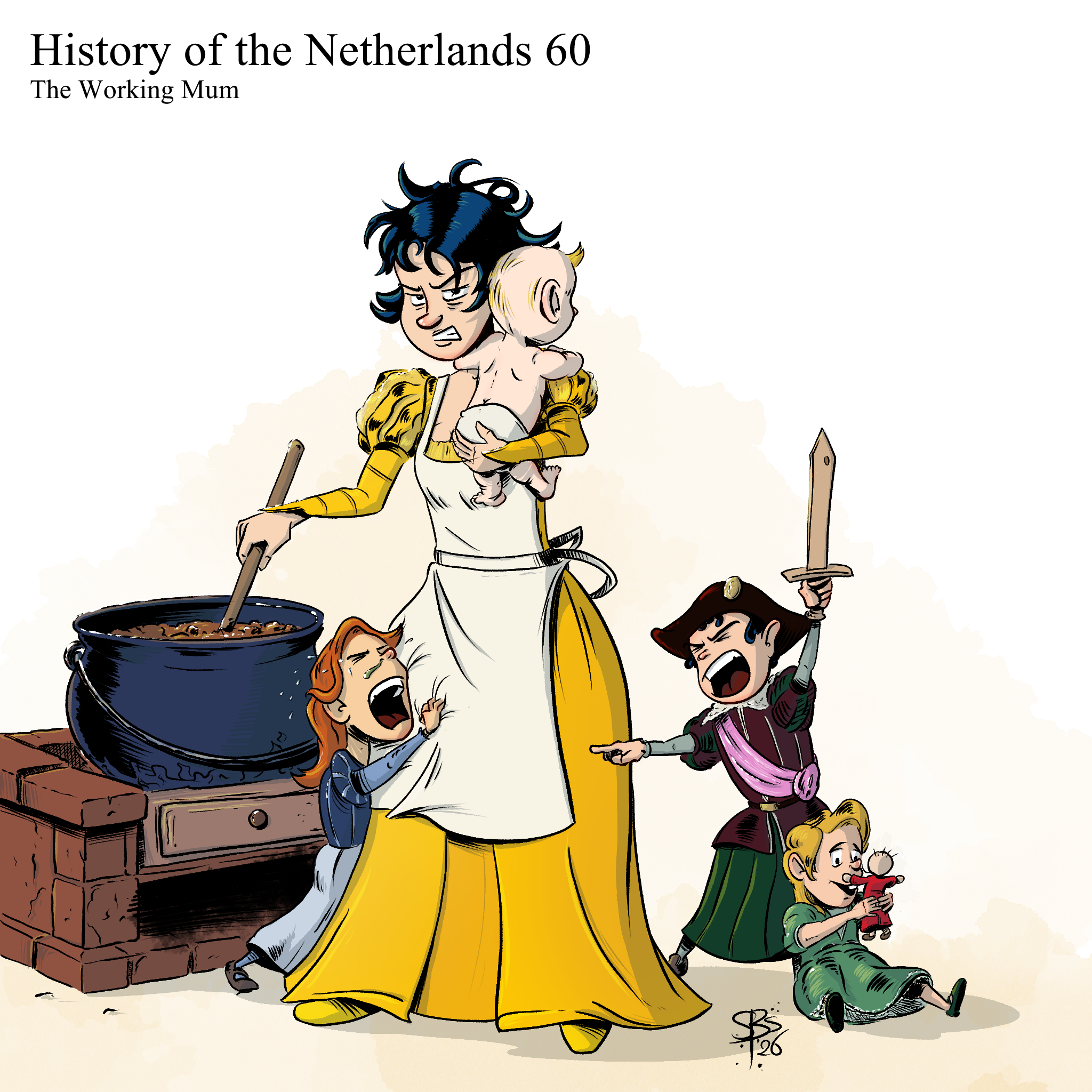
“The Working Mum” episode artwork by Steven Straatemans
Margaret of Austria becomes regent of the Low Countries
Margaret had still been in Savoy, mourning her late husband Philibert (a.k.a Savoy Phil) and working on building his tomb at Brou when news arrived of her brother’s passing in late 1506. As we have seen in previous episodes, Margaret of Austria was passionate about poetry and music. She would, in time, become an important patron of the arts through her court. She also ably composed poems herself and part of her processing the news of her brother’s death was through poetry, composing an epitaph in Latin rather than in her usual French. Translated into English, it reads as follows:
Behold, again a new sorrow comes!
It was not enough for the most
unfortunate daughter of the Emperor
to have lost her dearest husband;
bitter death must steal
even her only brother.
I mourn thee, my brother Phillip,
greatest king; nor is there anyone
to console me.
O ye who pass this way,
attend and see if there is any sorrow
like unto my sorrow!
Once again, a great and unexpected misfortune had shaken the foundations of Margaret’s life, which would drastically reshape her immediate future.
How those foundations were shaken, and her future reshaped are, happily for historians of the era, pretty well recorded, not just because of the extant chroniclers and servants of the Habsburgs, such as Molinet and de Lemaire, but also because of the continued correspondence between Margaret and her father, Maximilian. One 18th century French archivist, André-Joseph-Ghislain Le Glay, assembled a collection that boasted 513 letters from Max to Margaret, and 148 letters from Margaret to Max. Marian Andrews, who wrote her biography on Margaret reliant on these letters, wrote “at the same time we have a large correspondence of the Lady Regent of the Netherlands with her various councillors and generals, with prelates and tutors, with foreign kings and queens, with her nieces, and last, not least, with her nephew, Charles V, to whom on his early majority she resigned the supreme power.”
Included in all this is the official document in which Maximilian first bequeaths her that supreme power. Not only was Maragert given the governing responsibility on his behalf as regent of his grandson, Charles but, in fact, responsibility as the actual guardian of Charles and his siblings - his older sister, Eleanor, and younger sisters Isabel and Mary. Their two other siblings remained in Spain, a brother Ferdinand - who would much, much later succeed Charles as Holy Roman Emperor - was left in the care of his maternal grandfather Ferdinand of Aragon’s court, and the youngest sister Catalina remained in the care of her mother, Joanna, in the Castilean palace at Tordesillas.
When Margaret left Savoy in October 1506, she travelled north-east towards Stuttgart, meeting her father in the town Rottenburg am Neckar and then again in Strasbourg. On March 18, 1507, Maximilian made his daughter the ‘procureur général’ of the Netherlands. In doing so he gave her authority over “the guardianship, maintenance and government of our very dear and beloved children, Charles, Archduke of Austria, Prince of Spain, etc., and of his brothers and sisters... and we ordain our lieutenant general and governor and administrator of the persons, bodies and goods, lands, lordships and countries of our said children... with full and complete power and authority to do, provide and accomplish in all matters arising in the said countries... both in matters of justice, grace (or favours) and finance, offices, benefices, confirmations and freedoms, etc...” As her biographer Jane de Ionghe put it, “Equipped with this authorisation and accompanied by certain of her Savoyard councilors and secretaries, Margaret journeyed on towards the Netherlands to meet the task of her lifetime.”
It is interesting at this point to reflect for a moment on that ‘task’ and what it meant in the context of the socio-political development of the Low Countries that we have been immersed in over the course of this podcast. Here, we’re not talking about the policies, conflicts and issues that abounded the affairs of the Low Countries in this period. We covered those in the previous episode and will touch upon them again in the latter stages of this one. Here, we are talking more about the implications that arose from her simply being who she was. As a woman, Margaret was taking on the role of foster mother to her nephew and nieces; as housekeeper, it was a role that neatly fit the gendered expectations of her age. As a princess, however, she was taking on the role that her mother Mary of Burgundy had assumed upon the death of Charles the Bold, but which had come so burdened with the weight of ambition that was heaped upon Mary by the male dominated estates of the Low Countries, in the form of the Great Privilege. Maximilian had come onto the scene with such gusto because he was a high-ranking male prince who could be seen as a protector of Mary and her inheritance. However, their daughter Margaret had, by the beginning of her regency, gained such a greater wealth of worldly experience than her mother ever did. She was still a woman setting out to do a job in a patriarchal and misogynist social system though. It would take all of her wiles and the lessons learned from those previous worldly experiences if she was to successfully manage the duality of the task that now existed before her. One suspects that there were many amongst the ranks of the second and third estates (being the nobility and the various urban elite) who would have seen this as an opportunity to garner even greater freedoms, autonomy or facilitation and fulfillment of their own agendas, just as they had done when her mother had become Duchess. However, it seems that her being a ‘native’ to the lands bore the greatest weight in their support. In their book on the Burgndian Low Countries, Promised Lands, Walter Prevenier and Wim Blockmans tell us that “The independent stance of the "natural rulers" enjoyed the warm support of their subjects… the Estates General gladly accepted Philip the Fair's sister Margaret of Austria as governor-general…” In her tempered and considerate approach to ruling, Margaret would prove not to disabuse them of reason for this. Again, from Blockmans and Prevenier, “Her policies were more moderate and generally in agreement with those of the Estates General. And her goals did not involve new territorial acquisitions, but rather the achievement of a peaceful balance of power.”
The first thing she did after arriving back in the Low Countries was go to Leuven where she recited the oaths swearing to uphold those Privileges which the towns and states of Brabant held so dear to their hearts. Apparently, she utterly charmed everybody during her Brabantine entries. In the words of de Ionghe, “The people of the Low Lands were at that moment fully prepared to take her to their hearts. Her life as a princess, full of suffering and sorrow, worked on their imagination, her widow’s weeds compelled their respect, and they were charmed by her humorous eyes and generous smile. At her festive entry into Brussels the populace wept tears of joy and gratitude for the ‘national’ princess, and when two days later she went to the town hall, where the oath-taking ceremony took place, and appeared on the balcony to show herself to the people, their enthusiasm knew no bounds and she received ovations such as she, the much hailed, and never yet experienced.” Perhaps what this enthusiasm indicates is the great difference between what existed at this moment, compared to what had existed at the ascension of her mother to the ruling throne some three decades earlier. The people of the Low Countries had, since then, accrued their own experiences of being ruled by a foreign prince, Maximilian, whose time in direct charge had included the uproar of the Flemish Revolt, the take over of Friesland and the eruption of the Guelders war (even if its origins lay in the actions of Charles the Bold).
Actually, speaking of uproar… ding ding ding that leads us to today’s edition of your favourite section of this podcast, Bet You Didn’t Know That Was Dutch! Honestly, you probably should have known this one was Dutch, considering how many of these we have seen so far in this podcast series, but whatever. The English word uproar, meaning a loud protest or outrage, or a tumultuous excitement, comes from the middle Dutch oproer. Op means up, and roer means motion. An uproar is a rising up, or a revolt, and was first used to describe such in English in the 16th century. Over time, however, people started to use it more to describe a loud and chaotic excitement because, well, I guess roars are loud? So the next time your town is in uproar, be content knowing that you are following in a centuries-old tradition and simply being Dutch. Uproar! Bet you didn’t know that was Dutch. Back to Margaret of Austria.
Although Philip the Handsome had been a prince native to the Low Countries, his attention had also veered off towards foreign ambition and kingship. Perhaps the Brabanters and their kind were just happy that, in Margaret, they might have a locally focused, locally born leader again, even if she was female. Perhaps the fact that she was ruling in lieu of her underage nephew, who was, importantly, both male and native, also worked in her favour.
Despite the pomp and ceremony, Margaret was switched on enough to know how fickle was the fortune of a ruler who did not heed the natural inclinations of those existing within Dutch or Low Country culture. Again, as De Ionghe suggests, “she knew the way of Netherlanders, who acclaimed their rulers but were suspicious of their government; who wanted to govern themselves and had always refused to let themselves be used in the service of interests that they could not look upon as their own.” She also knew intimately that this understanding was bound to clash with the interests and aims of her father, on whose behalf she now held this position. His primary goal remained the continued and increased strength of House Habsburg - not just in the Netherlands but across Europe writ large - and he was not about to cease trying to utilise Low Country resources as means to achieve and maintain that goal.
The Court of Savoy in Mechelen
Let’s shift our attention to the town of Mechelen, called Malines in French. Mechelen had long played an important role in the Low Countries, having received the staple rights to wool, oats and salt from the Brabantine duke Jan III in the early 14th century, which we covered in Episode 14, before being made the home of Charles the Bold’s Rekenkamer, or Chamber of Audit, in 1473, which was the central financial authority of the Low Countries. A year after that, Charles established his Grote Raad, or Great Council at the Alderman’s house in Mechelen, all of which we spoke about in Episode 32. When he married Margaret of York in 1468, the town became a part of her dowry settlement, so that after the death of Charles the Bold in 1477, she retired to the town and there built her court, which from 1485 became the court of her young step-grandson and ward Philip. After being shunned by the French King, it also became the home of her young step-granddaughter and namesake, Margaret of Austria. You might remember that in Episode 57, as we were exploring Margaret of Austria’s wedding procession towards Savoy, she was accompanied for a short time by Margaret of York, before the two said an affectionate farewell on the outskirts of Brussels.
As we mentioned then, but to be fair probably did not pay enough homage to, that was the last time Margaret of York and Margaret of Austria ever saw each other. Margaret of York’s role as both a shepherd to Mary of Burgundy and her children in the aftermath of Charles the Bold’s death, as well as in the entwining of English and Low Country commercial, political and cultural affairs during this period - remember that it was she who had been the patron to William Caxton, who had thereafter introduced movable type printing into England - simply cannot be understated. In November 1503, aged 57, Margaret of York had died suddenly, shortly after the return of her beloved step-grandson, Habsburg Phil, from his first trip to Spain. The loss of the so-called Madame la Grande, was felt keenly by the people of Mechelen. With it, the grandiosity which had become such a part of the town had been lost somewhat. To quote Jane de Ionghe again if only for the lovely nature of her descriptiveness, when Margaret of York died “the court of Malines had lost its centre and the city lived withdrawn into itself and peaceful behind its ramparts and canals. Across the drawbridges, through the gates, a rural traffic moved all day long of carts and wagons, pedestrians and horsemen. The artisans of Malines, the bell and cannon founders, the tanners and drapers, brought their products along the waterway; and in the centre of the intimate little town, along the quays of the Dijle (the river) there was always a flapping of sails, a rattling of cranes and pulleys.”
Now, some four years later, the briefly quiet provincial town was to once again become a focal point of the Burgundian/Habsburg court in the Low Countries. That’s because Margaret of Austria, instead of selecting one of the powerful Flemish towns, such as Ghent or Bruges, now chose Mechelen to be the seat of her regency and it would remain her base for the rest of her life. Her foster children, Charles and his three sisters, resided still in the so-called ‘Keizerhof’, the former property of Margaret of York which had been bought back by the city government. Margaret did not set up her court there, though. It was seen as unsuitable to house the esteemed archducal house. Maximilian, therefore, purchased a large, if relatively modest winged house with stables that stood opposite the Keizerhof and the town paid for it to be suitably furnished, turning it into what became known as the ‘Court of Savoy’. Here, for the next two and a half decades, Margaret fostered both the future emperor as well as a court of political machination, patronage of poetry; and purveyor of painters and publishers. “...the spirit of courtesy and culture that reigned here contrasted favourably with the loose and drunken manners of so many other courts… Here she (Margaret) commanded in the capacities of ruler, of devotee of art and music, of educator and foster mother, of excellent housewife.”
Foster mother to Eleanor, Charles, Isabella and Mary
Even though her ward Charles would go on to become possibly the most famous Holy Roman Emperor ever and a central figure in possibly the most tumultuous century in European history (Ok there are definitely multiple contenders for that title), there is not a whole lot known about him in his youth. In the words of Eleanor Tremayne, who wrote a book about Margaret of Austria titled The First Governess of the Netherlands, “During the early years of Charles’ life we only get a few glimpses of a shy and inarticulate boy.” Firstly, we know that he was deeply cared for, not just by Margaret and her entourage, but by his paternal grandfather, Maximilian, who took a deep interest in the fortunes of all his grandkids. It will not surprise you to hear that, in particular, their potential marriage-matchings were of his keen interest from early on, just as had been those of his own kids. Charles, however, was “nostre tres chier et tres amez fils Charles - Our very dear and very beloved son, Charles”; unique because he was the heir, not just to Maximilian’s domains but also those of his maternal grandfather and his mother, being Aragon, Castile and the new world possessions. Amongst the earliest of the correspondence between Max and Margaret upon her assuming the regency, he shows a concern for their safety and took measures to protect them: “Dearest and most beloved daughter, we are pleased to announce how the archers of the late King our son, numbering fifty, have withdrawn to you, to have an account of their service with our dearest and most beloved son Charles, Archduke of Austria, Prince of Spain, etc.” We should not get ourselves too mixed up in modern notions of sentimentality in this regard. Maximilian’s aim was always the betterment of his House, which Charles’ person now represented. When, following the death of the Castilean Queen Isabella, her husband Ferdinand re-married to a French noblewoman and niece of Louis XII called Germaine de Foix, Maximilian’s letters show his concern that the two would conceive a son that might threaten the inheritance of Charles. He was reassured at one time to find out that Germaine de Foix was not pregnant, which he communicated to Margaret. Love, ambition, pride, sentimentality and opportunity all swirled together in Maximilian’s idea of a healthy paternal care. We know, for instance, that he gave Charles a wooden horse as a toy and that the boy loved playing games, which is pretty standard stuff. He was literally entitled and a competitive boy, needing to be on the winning side; for instance, he would play Christians vs Turks with his pages, in much the way that in the 20th century kids used to play cops & robbers or other, just as politically and socially incorrectly named games, like Cowboys & Indians. When playing these, Charles always got to be the Christians, which were therefore always made to win, which his page complained about. He learned archery and warfare and showed the kind of love in hunting that Maximilian - the consummately depicted warrior prince - rejoiced in. Max wrote to Margaret, boasting of this as clear proof that the young boy took after his grandfather (- and this is our translation; courtesy of Dr Google) “We were overjoyed when our son Charles took so much pleasure in hunting; otherwise one might think he was a bastard.”
Let’s go back to Eleanore Tremayne to complete our image of Charles, the young prince upon whose Empire the sun would never set:
“Charles as a child is described as graceful and well-built, but his face was pale, and he looked delicate. His long projecting lower jaw, so peculiar to the Habsburg family, embarrassed mastication and caused hesitation in his speech. He had clear and steady eyes, and a calm, intellectual forehead which gave a pleasant and dignified expression to his face…Charles was devoted to music, a taste which he cultivated throughout his life.”
His education was paramount, overseen by Margaret (and from afar by Maximilian), but conducted by some of the most notable European intellectuals of the day. The Lord of Chievres, Guillame de Croy, whose job Margaret had basically taken following the death of Habsburg Phil, was made his governor and two successive Spaniards took responsibility for his learning, in the humanist Juan de Verde and another called Luis Cabeza de Vaca, both of whom would go on to become bishops and cardinals. When Charles was nine years old the role then went to the Dean of Leuven, a guy called Adrian of Utrecht, who would later go on to become the only ever Dutch Pope, Adrian IV. Unlike his grandfather and aunty, however, Charles was not so keen on, nor good at languages and literacy. Again from Tremayne, “The future ruler of so many vast kingdoms was never a good linguist. He learned very little Latin, and was never proficient in German. Two years after he became the King of Castile and Aragon he only knew a few words of the national language. His knowledge of Italian was barely elementary. Flemish was the tongue of his birthplace, but he did not begin to learn it until he was thirteen. French was his natural language, but he neither spoke nor wrote it with any elegance.” If you’ve listened to any of my recent pronunciation of French names and words, you would have noticed that I model my approach to French elegance on Charles V. If you haven’t hold on to you britches ‘cos I am gonna mangle plenty more in the next 45 minutes or so.
The passing of the baton
On the 18th of July, 1507 the citizens of Mechelen joined the members of the Habsburg/Burgundian court in a “great procession” that wound its way through the city. They were joining the ceremony that would mark and mourn the passing of one King, and herald in the ascent of his son. Jean de Lemaire, the nephew of Molinet and chronicler for Margaret of Austria, recounted the event, which Margaret’s biographer Marian Andrews brings together:
“All the people of Malines (Mechelen) have come forth to do honour to their dead lord and master, and the great procession slowly threads its way through the quaint, narrow streets of the ancient city. Certain officers and valets of the late King lead the way, then follow at set intervals the various processions of all the churches and all the guilds of Malines in state costume, bearing a myriad of crosses and banners which wave above the motley throng of priests and chaplains, of begging friars, men of law, deputies of the states in their robes of office, officers of the late King Philip and of Monseigneur the Archduke Charles; closely followed by a great number of honest poor, each of whom bears a torch with two flares, and who on reaching the nave of the church will ‘kneel on both knees’ all the time the solemn service lasts.
The way is thus prepared for the most magnificent and stately procession of all the ambassadors, the bishops, the great lords of the land with their arms set forth in full; each contingent led by gorgeous heralds in coats of arms, on massive war-horses richly accoutred, with their emblazoned silken banners flaunting in the breeze. We see the arms and banners of Habsburg and Burgundy, of all the broad provinces where their rule extends, and of all the mighty ancestors of dead Philip; that of the Emperor Frederick with the Golden Fleece (Max’s dad), of Charles, Duke of Burgundy (the Bold), and many another…”
In Lemaire’s own words, written for his patroness, he speaks to Margaret:
“You, gracious lady and Princess, were also present, secretly praying in your oratory for the soul of ‘your unique brother, may God absolve him’... There were many heavy sighs all around and tears without number…and I believe, Madame tres gracieuse, you also were secretly weeping in your oratory. “
At the end of the High Mass, held by the Bishop of Arras, he spoke the words “Et verbum caro factum es” (And the word became flesh), and what followed was a scene directly from the modern imagination of medieval custom. Again, this is related by Marian Andrews, who took it from de Lemaire’s account. The description reminds us that this small moment of time very much represents our modern understanding that, at the moment of Philip the Handsome’s mourning ceremony in Mechelen, European society stood on a pivot, with one foot still nestled in the devotional pageantry of the middle ages, whilst the other shuffled precariously forward into early modernity. At the centre of this epochal shift was the seven year old Charles, who was about to take over the reins from his late father and whose rule would oversee the massive social changes that were about to take place. Of course, none of them knew this at the time, and it is a mere luxury of hindsight that allows us to view events through this lens; just as it will be the luxury of those who come after us to view cuurrent events as such. Charles was dressed in the appropriate mourning attire of a prince, a monastic robe that likely included a capuce, a deep, pointed hood that hid most of his face. It was commonly worn by the ruling elite during mourning ceremonies. He basically would have looked exactly like a young Jedi stealthily surveying a Tatooine tavern.
Upon the bishop uttering the concluding words of the mass, et verbum caro factum es, signifying the worshipper's devotional reverence that God chose to become human in the form of Christ, the heralds present lowered the banners that they had held aloft and placed them on the ground, at which point the King-of-Arms of the Golden Fleece, believed to be a man called Thomas Isaacq, whose role involved overseeing heraldic protocol and procedure, cast his own staff of office down upon the marble floor and, raising his voice to the heavens, shouted passionately ‘Ley Roy est mort! Ley Roy est mort! Ley Roy est mort!’ The king is dead! The king is dead! The king is dead!
Letting this fact settle for a while upon the assembled mourners, he thereafter picked up his staff, held it aloft and proclaimed ‘Vive don Charles par la grȃce Dieu archiduc d’Austrice, prince des Espagnes!’ Long live Don (meaning highest Lord) Charles, by the grace of God the Archduke of Austria, Prince of Spain…” Swiftly, the heralds in order picked up their own banners again, in an orchestrated way each rattling off more of the titles to which Charles was ascending. “...of Burgundy, Lostrick (which is an old-school term referring to Lotharingia or the Low Countries), and of Brabant.” The next herald continued and then the third and fourth: “Count of Flanders, Artois, Burgundy, Palatine of Hainault, of Holland, Zealand, Namur and Zutphen, Count of Charolais… Marquis of the Holy Roman Empire, Sovereign of the Frisians, of Salins and Mechelen!”
Following this, Charles’ jedi hood was lowered onto his shoulders, revealing his young face, at which point Thomas Isaacq retrieved a big, ceremonially blessed sword and held it out to him, beginning a long and, I would imagine pretty arduous speech with: “Imperial and royal Prince, this sword of justice is given to you from God… and from your noble ancestors… that you may protect the Most Holy Faith and all your kingdoms…” end quote here because… well that’s enough of that.
When he was finished, Isaacq kissed the sword and gave it to Charles. The young boy who, over the next decades would add even more incredibly vast domains to those which he had just been granted and who would rule them for the next half century, took it by the hilt, knelt before the altar, and accepted his father’s inheritances, along with all the consequences by which they would be accompanied.
The challenge of being Maximilian’s daughter
So of course, other than simply settling herself back into life in the Low Countries and becoming head of the ducal household, Margaret of Austria faced a raft of challenges upon becoming governess. Perhaps the most constant and intractable of all the difficulties was simply the personality of her father, Maximilian. As we have seen time and time again throughout this podcast, Maximilian was an ideas man, who was constantly coming up with grandiose plans, which could range from crusades into the Holy Land and invasions of Italy so that he could finally formally receive the imperial crown, to blocking the expansion of the French wherever he could. One suspects if he was rocking around today he would be diagnosed as ADHD or neuro-divergent. Given the nature of his empire, Maximilian was required to constantly travel between his lands so that he could raise armies, go on campaigns, attend diets, beg for money, or, of course, go hunting. Marian Andrews nicely sums this up it as follows when she is describing the correspondence between Maximilian and Margaret of Austria: “we obtain some idea of the extraordinary energy and restlessness of the Emperor Maximilian when we find that his letters are addressed from over a hundred different places scattered throughout his vast dominions: from an ancient city, a busy seaport, a country village, a tent encamped before a hostile town, or the isolated castle of some feudal stronghold. As we study his letters, we become more and more impressed by his marvellous vitality and the perennial youthfulness of his outlook on life”. Maximilian’s scattergun approach to his life and rule meant that he was unpredictable and Margaret could never be sure in which way her father might try to meddle in the affairs of the Low Countries. Her authority could easily be undermined if she and her father were in disagreement. Still, Prevenier and Blockmans go as far as to say that it was clear that Margaret (and her brother before her) “...did not consider themselves to be instruments of Habsburg dynastic politics, choosing instead to pursue an independent policy intended to preserve peace in the Low Countries.”
This highlights one of the general issues which a composite monarchy such as the Low Countries faced. The Emperor was, of course, at the top of the feudal pyramid, but the lands which he ruled were, theoretically at least, independent of each other and their various interests could and often did clash with each other, as well as with the interests of the emperor. Maximilian as emperor wasn’t wearing one giant hat labelled “my empire”, but rather wearing lots of little ones with labels such as: “County of Holland”, “Duchy of Brabant” etc. If someone was reaching over trying to steal one of those hats, he would have to slap it away but doing so sometimes meant the other hats would get squished a bit in the process, which they were very unhappy about. It’s a bit of a tortured metaphor that demands the anthropomorphising of hats, but you get the idea of what I’m saying. When you add in to that mix a regent, it becomes unclear who exactly was holding the reigns of power in terms of the relations that the Low Countries had with the rest of Europe. Maximilian? Margaret? The States-General? The local States themselves? In Monarchies, States-Generals and Parliaments, historian Helmut Koenigsberger neatly sums it up as follows: “...who would take the ultimate decisions in foreign policy and with what ends in view. Were these ends simply the defence of the Netherlands against aggression from outside or were they the interests of an international monarchy?”. Margaret of Austria was going to need to carefully walk a path through this convoluted mess in order to establish herself in her role as regent. Just as had been the case during her brother’s rule, Margaret’s first regency (yes, there will be a second regency which we will get to in due course), would need to constantly resolve the conflict inherent within a system that married a composite monarchy with a society that revered local freedoms and privileges, summarised by the contemporary term Dominicum politicum et regale, meaning ‘from political AND royal dominion’, but better expressed as ‘government with consent of the governed’.
Extricating herself from a marriage proposal…
Margaret’s first official foray into Low Countries governance would necessitate her tackling the treaty her late brother had been coerced into signing with English King Henry VII when he accidentally got stuck in England on his way to Spain. This was the horribly lopsided deal which became known as the Intercursus Malus, or the Evil Treaty. This treaty removed duties from English cloth which was sold in the Burgundian lands, but not the other way around, meaning that English merchants were put at a huge advantage compared to competitors from the Low Countries. In addition to this, Habsburg Phil had agreed that Henry VII could marry Margaret of Austria, so recently widowed. In her new role and given her life experience up until then, neither of these were terms that Margaret of Austria could abide.
Maximilian had been delighted when he heard the news about the intended marriage between Margaret and Henry Tudor. Margaret herself was… less so. She was 26 years old and had been married off three times already, one ending in a humiliating annulment and two ending in the premature deaths of her husbands. Remember that before the latter of these, she had refused to sign a declaration foisted upon her by her brother that stated she was not being forced into it. Even if she did go through with it, she had clearly let it be known that she was getting fed up with being their pawn. Margaret had, by this stage in her life, accumulated enough emotional and worldly experience that she was no longer willing to go along with her brother and fathers’ plans for her life and steadfastly refused to marry the English king. On July 30, 1506, a member of the Council of Flanders named Jean le Sauvage wrote to Maximilian, “the Archduchess Margaret decidedly refuses to marry Henry VII, although he, at first by himself, and afterwards conjointly with the Imperial ambassador, had daily pressed her during a whole month to consent”. Around a week later, Guillame de Croy wrote to Maximilian to say that “he is afraid that the refusal of the archduchess will cool the friendship of Henry”. But Margaret would not back down, telling another of Maximilian’s ambassadors named Claude Carondelet that “although an obedient daughter, she will never agree to so unreasonable a marriage”. As had always been the case, throughout her entire life, the matter of her marital status was on the lips of rulers around Europe. Amongst the documents belonging to Louis XII was one that conducts the exact same message, reading: “...already three times they (being her father and brother) have contracted for her, and she found herself the worse for it.”
It was pretty typical of Maximilian’s eagerness to complicate things for the betterment of his House that he persistently sought her to take on the mantle as England’s Queen consort. Although counter-factuals are historical bear-traps that do not prove very useful, it is nonetheless a super interesting ‘what-if’ to think about had she relented. Furthermore, it’s our podcast and we can speculate all we want. Had she accepted the marriage to Henry Tudor, not only would Margaret have then sat in the royal courts of all of France, Spain, the Empire and England, but also would have become the step-mother (and sister-in-law) to England’s next King, whose eventual infamy as Henry VIII knows no equal. One cannot help but wonder how she would have reacted to the treatment that her young sister-in-law Catherine of Aragon was due to undergo in the coming years, were things to unfold in a way that would see Margaret involved in the affairs of the English Reformation… Anyway, let’s not get ahead of ourselves, nor venture too far into the realms of what did not happen.
In Le Glay’s archival collection of their correspondence, there is one letter from Maximilian to Margaret, dated September 1507 that gives remarkable insight into both of their personalities, as well as those of both the English monarch Henry VII and his son and now-heir, the future Henry VIII (Henry VII was 50 years old by this stage, while Henry the junior was 16 years old and would famously and, it might be said, quite regrettably for everyone involved marry Catherine of Aragon two years hence). “We have also thought on this subject that if you will agree to this marriage which we wish to put forward, as he (Henry VII) by no means wishes to marry his son to you, in order that you may not be his prisoner; which is most to be feared, seeing that he is a headstrong man, and that you will not afterwards be able to do service to our House of Burgundy unless your marriage is expressly declared, and unless he is content that you may have the government, with us, of the lands of Brabant and others ‘de par delà’ (remember the old Burgundian term for the Low Countries: ‘the lands over there), and in order that he be content in making the marriage between you two, that in the treaty of marriage it be expressly declared and promised that you shall be able to serve us in our government for one quarter, or four months in the year, or a little more in case of our absence, according to the necessity, so that you may be able to do this in content.
We require that you send us news by this posting as soon as possible, and we beg that you will agree to this marriage in such fashion; for it seems to me that by this sort of marriage you will be quit of the prison which you fear to enter, if you were married to the aforesaid King of England, seeing his hard and plain head to leave me in peace;for also by this fashion you will govern England and the House of Burgundy, and you will not be wandering about the world, like a person lost and forgotten, as you once said to us.”
So Max’s plan was to forge an alliance with England that would leave him in peace, by marrying off Margaret to the English monarchs with the terms of the marriage being that she could come back to the Netherlands for a quarter of the year or whatever suited him, and so be involved in the rule of both domains. Wishful thinking!
Margaret skillfully fended off all these efforts mainly by insisting upon her right to a mourning period, which included the oath to build a mausoleum at Brou and revitalise the monastery there. In the words of historian Lorraine Attreed, in her article ‘Gender, Patronage, and Diplomacy in the Early Career of Margaret of Austria (1480-1530)’, “Planning for the Brou project certainly provided Margaret with some welcome diversion as she resisted their overtures, which included emotional blackmail, while she gradually mastered the complexities of international negotiations. But Margaret’s seeming passivity can be read in other ways. In essence, she would play the widow card for at least a short time, insisting on spending her period of mourning undertaking the vow to build Brou for her husband’s tomb. No one could criticize such an appropriately pious activity, which Margaret managed to spin out as long as possible.” This worked for a while, but even after the death of Habsburg Phil in September, 1506, Maximilian and Henry VII kept making efforts to try and get Margaret to marry the English king. Henry wrote to Maximilian on October 1st that “he has been informed that Madame Margaret makes great difficulties about ratifying the treaty of marriage.” Despite Henry VII’s wishes, Margaret remained resolute in her decision and neither she, nor Henry VII, would marry again in their lifetimes.
…and a terrible trade agreement
Although she had rebuffed his marriage proposals, in her new role as regent in the Low Countries, Margaret would still have to deal with Henry VII in order to undo the Intercursus Malus trade agreement. Margaret had already proven herself a capable administrator while ruling Savoy and, to be so, she had learned to be aware of the needs and wishes of the people she was ruling. With the unrest of the Guelders war wreaking havoc around the country, she had to create some sense of stability and regaining the terms of the previous trade agreement, the Intercursus Magnus, was her best chance of doing that. Having learned directly from some of the most able and powerful women of the age - Anne of Beaujeu, Margaret of York and Isabella of Castile, all of whom had taken her under their wing at some stage - she was not silly enough to outright reject the overtures of Henry VII. Instead she kind of strung him along. Eleanor Tremayne describes a conversation between Maximilian and one of Henry’s ambassadors, “the emperor told the English ambassador that the archduchess was fully aware of King Henry’s many virtues, and that should she marry again, she would marry no one else but him. But as she has already been three times unfortunate in her marriages, she is much disinclined to take another trial. Besides, she said she believed she should have no children, and that she might thereby displease the King of England”. Margaret’s picture was even hung up at the English court, which was like the medieval aristocratic version of swiping right on a dating app, so he must’ve felt he was in with a shot. His ambassadors would keep pursuing her for another year, hoping she would change her mind.
Margaret had to tread carefully in her negotiations with Henry VII. She was aware of how precarious Tudor-Habsburg relations were, especially given that her father seemed to have no middle ground between committed friendship or outright enmity and had also clearly gained no trust from Henry through his tacit support of Edmond de la Pole. She made the opening entreaty to Henry, writing to him not about marriage but about markets, and urging him to renounce the Malus Intercursus. She also requested help in solving the sticky situation of the Guelderian war. And lo and behold, Henry VII actually relented! In a letter dated May 1507, Henry VII wrote to Margaret of Austria informing her that “for the desire and affection we have to please you and satisfy your said request, and especially for the honor and love of you, inasmuch as it is the first request you have made to us, we are content to agree and grant that the subjects on either side visit, frequent and [communicate] together by virtue of the said first treaty”. Henry directed his merchants, who had already begun to prepare their markets at Calais, to instead go to the Dutch markets on the condition that the agreement of the Intercursus Magnus be retained. He also promised that he would put all his efforts into preventing a French invasion of the Low Countries On June 5, 1507 the new treaty was concluded. The Intercursus Malus was dead, long live the Intercursus Magnus!
That being done, Margaret was now firmly entrenched in her new dual role as a working mother, bringing up four kids while trying to rule a composite domain, her subjects variously characterised by their diversity, religious devotionalism, commercialism, agriculturalism, urbanism, autonomy and sectarian violence. While she oversees the growth of her nephew and his sisters, she will also need to find a way to continue balancing the requirements of sustaining the supremacy of her father’s House, dictated by his imperial and scatter-gun motives, while catering to the many domestic needs of her subjects, which were often in direct conflict with those motives. She will need to maintain good commercial relations with England, whilst not getting caught in another relationship that would leave her either forlorn, fettered or forsaken to the whims of a tyrannical English king. We haven’t touched upon Guelders in this episode, nor the continued meddling of the French king, but as we covered in the previous one, those linger as the main internal matters put before her, now that the unfair trade relationship with England had been resolved. All of her wiles, wits and worldly experience will need to come to bear if she is to succeed. All that, however, and more, is for future episodes of History of the Netherlands.
Sources used:
Monarchies, States Generals and Parliaments by Helmut Koenigsberger
The Promised Lands by Wim Blockmans and Walter Prevenier
Margaret of Austria: Regent of the Netherlands by Jane de longh
“Renaissance Portrait Translations” https://www.clausura.org/copy-of-psalms-requiems-translations, last accessed 29 June, 2026.
The high and puissant princess Marguerite of Austria, princess dowager of Spain, duchess dowager of Savoy, regent of the Netherlands by Marian Andrews (pen-name Christopher Hare)
“Wonderful Mechelen: From Burgundian Grandeur to Media Lab and Malt Whisky” by Frank Hellemans https://www.the-low-countries.com/wp-content/uploads/2024/08/TLC_23_GrootDeel_-FrankHellemans.pdf last accessed 29 June, 2026.
Correspondance de l'empereur Maximilien Ier et de Marguerite d'Autriche ... de 1507 à 1519, Volume 1 by M. Le Glay.
The First Governess of the Netherlands: Margaret of Austria by Eleanor E. Tremayne
“The armorial panels of the knights of the Golden Fleece in Mechelen: material witnesses to the political history of the Low Countries at the end of the fifteenth century”, by Claire Toussat, Alexia Coudray and Monika Drlikova, Bulletin de l’Institut royal du Patrimoine artistique / Bulletin van het Koninklijk Instituut voor het Kunstpatrimonium [Online], 37 | 2022, Online since 01 October 2022, connection on 29 June 2026. URL: http://journals.openedition.org/kikirpa/369; DOI: https://doi.org/10.4000/kikirpa.369