
Episode 59: Successive Crises Amidst a Looming Succession Crisis
During the first decade of the 16th century, one of the primary concerns for the towns, cities and ducal governments of the Low Countries was the war the Habsburgs were waging with Charles of Egmont over the title of Duke of Guelders. The war in Guelders complicated the already convoluted political structure that had developed across the Low Countries over the course of the previous half century. In this episode, we’re going to focus on Guelders again, but this time to see how the war was intimately entangled in a web of relationships between the different layers of nobility, both domestic and foreign, and how the interests of the Habsburg dynasty often clashed with the interests of the people who lived within their domains. When Philip the Handsome sailed away to Spain, Charles of Egmont seized the opportunity to restart the war, meaning the defence of the Habsburg lands was left to the man Philip had put in charge in his absence, his Stadhouder General, Guillame de Croy, the Lord of Chievres. Philip’s premature death would completely rearrange the pieces on the chess board as the Low Countries were once again plunged into a succession crisis. There was one giant mess left behind for the person who would ultimately become regent for Philip’s infant son Charles to clean up... And that person would be Philip’s sister, Margaret of Austria.
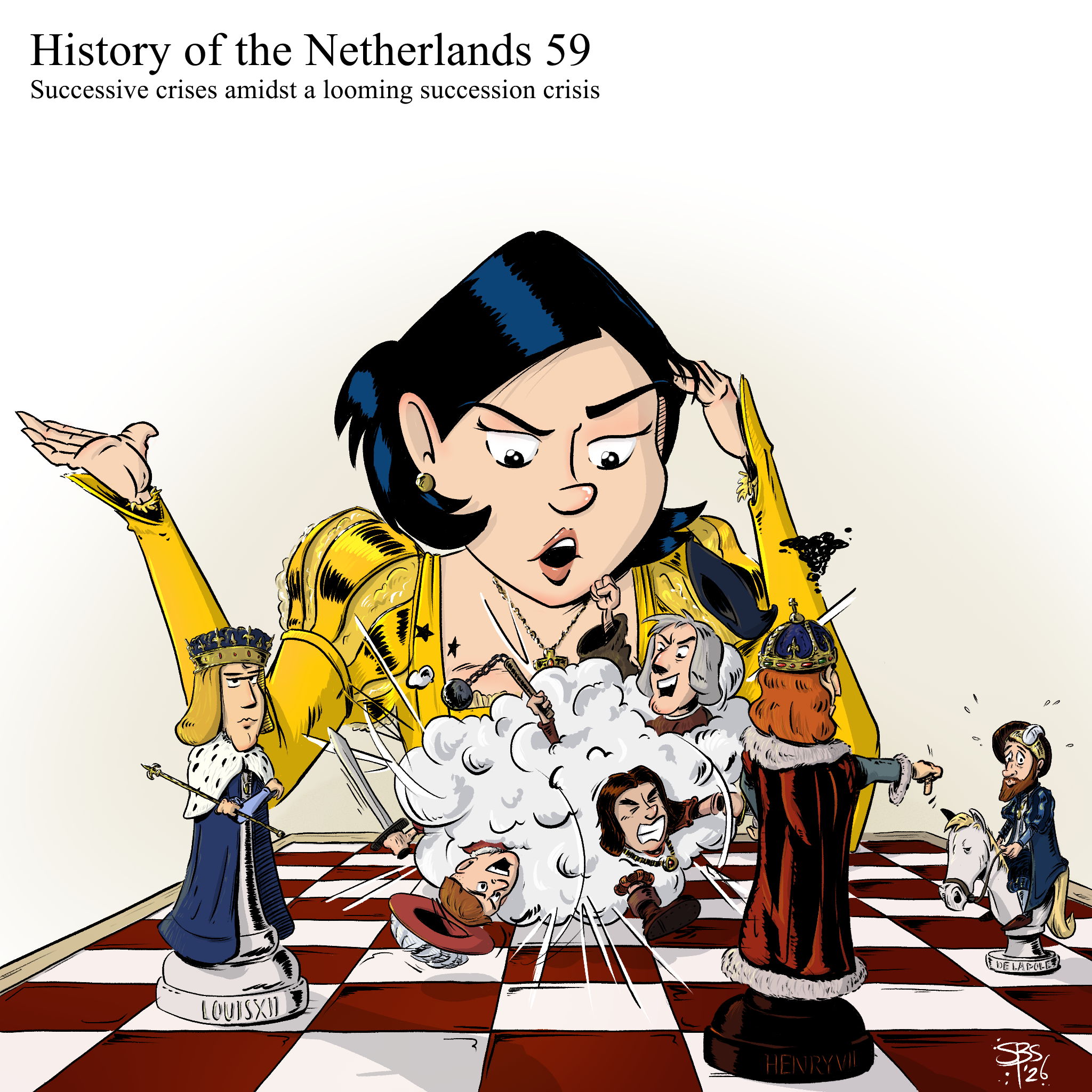
“Successive Crises Amidst a Looming Succession Crisis” episode artwork by Steven Straatemans
Conflicting loyalties through Guelders
As just mentioned, the political structures of the Low Countries at the start of the 16th century were complex. We already well know about the autonomous nature of the Dutch towns and cities, whose concerns ranged from maintaining their commercial viability - particularly related to the important trade connections with England, to the factionalism that had erupted in the conflicts between Hooks and Cods in Holland or the Schieringers and Vetkopers in Frisia, to the imposition of an imperial agenda on the Netherlandish estates by the as-good-as-Emperor Maximilian in his capacity firstly as the husband of Mary of Burgundy and then as regent for his son Philip. There was also the constant need for vigilance against the machinations of the French king, whether in the form of Louis XI, Charles VIII or, since the latter’s death by door-frame in 1498, Louis XII. Maximilian’s enmity with the French king had fuelled a seemingly in flux web of alliances that spanned western Europe and which played out on battlefields on both sides of the Alps.
In this episode we are going to keep focusing on Guelders, but in ways which highlight how the issue of Guelders fit into the complexities of all of this and which demonstrate how different the lens of political development was 500 years ago to, firstly, how it is today, but also to how we tend to look back at the past. Whenever we are casting our eyes back at history, it is almost impossible to do so without the filters that have been constructed in the years, decades and centuries since the events we are looking at. For example, take the name of this podcast: History of the Netherlands. Any astute and committed listener (we love you) will have at times been well aware that we spend almost as much time talking about areas that are NOT the Netherlands, as we do otherwise. That is because if we are to successfully build up the narrative of events and characters that contributed towards the existence of the state of the Netherlands as we know it today, we need to recognise that those people had no idea, intent or sense of what that modern state could be. At the higher levels of aristocratic politicking what mattered - to people like Maximilian and the French king - was themselves, their bloodlines and, usually, the establishment or continuation of their own dynasties. Policies were often made by personalities. The French king was the French state. Maximilian’s agenda was the House of Habsburg, not the internal stability of life for people living in territories that he saw as belonging to him by virtue of God. To him, he had as much right in making decisions about Turkish encroachments upon the areas of Hungary and Eastern Austria as he did in which prince his daughter should marry or what arrangement should be made with the English king regarding trade with Dutch towns. Maximilian’s example is a macro one, but there were nobles of all different… I want to say ‘sizes’ but might just say… levels of influence, for whom this was the lens through which they saw the world. They each had their own agendas that were not necessarily aligned with what was best for the societies and communities that would make up the polities that would much later be labelled with all encompassing national identities, like ‘the Spanish, the French, the Dutch etc’.
One man in the Netherlands whose position during the outbreak of the Guelders war epitomised these complications which embroiled the Low Countries was the imperial Count Oswald van den Bergh. His territory lay between Guelders and Cleves and he was a bannerman and vassal to the Duke of Guelders. As a young man, he had undertaken a pilgrimage with Adolf of Egmont, the father of the man who defiantly claimed this title, Charles of Egmont, against whom Maximilian and Philip the Handsome were in conflict over the Duchy of Guelders. Despite this intimate connection to the Egmonts, being an imperial count meant Oswald was also a vassal of Maximilian, so he cleverly sought not to get too involved in the conflict between Charles of Egmont and Maximilian. He remained fairly neutral throughout the increase of tensions and eruption of conflict between the two of his liege lords, even though the violence that raked the lands around him also spilled into his domains from time to time. In one of Maximilian’s failed attempts to subjugate the Upper-Quarter of Guelders in the late 1490s it had looked like he was going to attack the lands of Oswald himself, but was held off by the defiant citizens of Zutphen at Elten. Shortly after, in his capacity as King of the Romans, Maximilian then summoned Oswald to come to Worms with an armed force so that they could go fight the Turks together. Talk about an emotional rollercoaster! The fact that Maximilian had so many fingers in so many pies but that his reach into the Low Countries flowed through his paternal connection to its ruling family certainly contributed to the generally complex nature of the situation there. If Oswald did obey his imperial overlord, he would also be greatly irritating Charles of Egmont, his rebellious but powerful lord and the son of his dear, late friend.
Oswald felt that the autonomy of his house and lands were paramount and when Maximilian pushed for Oswald to swear an oath to him as the Duke of Guelders, Oswald was very reticent to do so. In the end, however, he, like many of the Ducal bannermen of Guelders, succumbed, largely because Maximilian was already his imperial suzerain so, were he to be recognised as the Duke of Guelders as well, it would make Oswald’s life that much easier. As a consequence for doing this, Charles of Egmont promptly declared Oswald’s possessions forfeit and captured his castle of Nijburg. In early 1499, Maximilian did his usual thing and got distracted by a war in Italy and pretty much abandoned the fight in Guelders, leaving van den Bergh surrounded by enemies, seen as a traitor by Charles and bereft of help or consideration from his imperial lord whom he had staked his future on.
When Oswald learned in September, 1500, that Charles was about to plunder his lands, he sought help from the towns of Arnhem, Nijmegen and Zutphen, who managed to broker an agreement. This involved Oswald paying Charles a heap of money and Oswald’s son pledging allegiance to Charles, who would enfeoff him once Oswald had kicked the bucket. The autonomy of van den Bergh, despite Oswald’s best efforts, was going to be snuffed out whether he liked it or not. In 1502 Charles of Egmont broke the truce between himself and the Habsburgs and went on the expedition that saw him being rescued by Jacob the Moor following a failed attack on the town of Huissen.
Maximilian went on the offensive in Guelders again in 1503, though Oswald managed to come to a truce with the Habsburgs in 1504. This was presumably undertaken in negotiation with Habsburg Phil the Handsome, who was by then also calling himself the Stadhouder-General of Guelders and Zutphen. A letter purportedly from Oswald to Philip (using the abovementioned title) exists in the archives of Huis Bergh which outlines Oswald’s desires in negotiating the peace, such as getting back the lands and titles that Charles of Egmont had dispossessed him of as well as gaining a couple more. As Michiel Faber wrote in his dissertation on the topic titled Tussen Gelre en Habsburg / Between Guelders and Habsburg, “Whether this letter was ultimately sent is unclear. However, it does indicate that Oswald believed there was room for negotiation.” Oswald did not get everything that he had sought, but he and his son did swear loyalty to the Habsburgs in 1505 which kind of restored the autonomy that he had sought to preserve. In 1505 Maximilian invested Philip the Handsome with the title Duke of Guelders, after which Philip led the campaign which saw the Habsburgs occupy two of the four quarters of Guelders and capture Charles of Egmont. This led to the tenuous peace of the Treaty of Tiel which we spoke about in the previous episode, where Charles was supposed to go to Spain with Habsburg Phil but instead did what I think I would do if I ever found myself in armed conflict and ran away towards home. LOL
The case of Edmund de la Pole
There is a slight tangent which we want to go down here, as it ties together some reference points which have long been made in this podcast, including in the previous episode when we spoke about Philip getting stuck in England following a storm while on his way to Spain and then being coerced into the Intercursus Malus (the evil trade agreement) by English king Henry VII. It is a story that demonstrates how, what might be called ‘the history of England’ can also be ‘the history of the Netherlands’, ‘the history of France’ or ‘the history of Spain’, because those involved in the decision making processes at the highest levels did not see themselves as defined by the national boundaries that have been discerned since, and which we recognise today. (Not to mention the all-encompassing identity marker of ‘Christianity’ that swept over all of them)
You might remember that part of the Malus Intercursus was the forced return of an English nobleman called Edmund de la Pole, the 3rd Earl of Suffolk, who was the last remaining Yorkist claimant to the English throne. Well, the story of Edmund de la Pole is enticingly intermingled with those of many of our protagonists and highlights several key points about the events and characters whom we have spent so much time talking about, it also shows how the Guelders wars meant something different from the upper-nobility of Europe than what it did for the everyday Kees and Geertruid whose towns and villages were laid waste in the process. The fate of Edmund de la Pole was of the utmost importance amongst the many in the elite of Western European society, whilst being of zero importance to pretty much everyone else. So down the rabbit hole we go!
Edmund de la Pole’s grandfather had descended from the English King Edward III and had been the Duke of York. So, at the turn of the sixteenth century, after the wars of the Roses between York and Lancaster had pretty much been concluded, Edmund actually had a stronger claim to the throne than the incumbent king Henry VII, who came from a dubious Lancastrian lineage and was sometimes, or even often, referred to as a usurper. The biggest champion of the Yorkist cause outside of England was, as we well know, that magnificent woman Margaret of York who had helped to raise Philip the Handsome and Margaret of Austria in her role as their step-grandmother. Margaret had long been a bane of the young Tudor dynasty (which, by the way, was not at this time called the Tudors by anybody except perhaps some detractors, and was not yet a dynasty). She had funded more than one expedition to put a Yorkist on the English throne, including the imposters Lambert Simnel in 1487 and Perkin Warbeck ten years later, both claiming to be one of the fabled princes in the tower.
When Edmund de la Pole was arrested in 1498 for killing a commoner he was offered a pardon if he swore an oath of fealty to Henry VII (Henry Tudor). Instead of doing this, Edmund fled to the continent and sought refuge with the Archduke of Burgundy, Philip the Handsome, and his imperial father Maximilian. As both were seeking good relations with England (remember that Maximilian’s focus was on maintaining the anti-French coalition between him, the Spanish monarch and England), he advised de la Pole to suck it up and submissively return to England and earn Henry VII’s favour. Though he tried to do this, it did not last long as, in June 1500, Henry met with Philip the Handsome in Calais and sought to humiliate de la Pole once again, by forcing him to swear an oath in front of them both.
Over the next year, de la Pole stewed in his own anger. Unbeknownst to him, however, Maximilian was also doing Maximilian things. One of the Emperor’s main goals was to raise an army against the Turks who were threatening his familial lands in Austria. It is thought that Henry VII got in his bad books by refusing to lend any support for this endeavour. It also seems that a Yorkist sympathiser from England called Robert Curzon, who had come into Maximilian’s favour, had gotten in his ear about returning the so-called ‘White Rose’ (the appellation used for a Yorkist claimant) to the English throne. According to W.E Hampton in his work ‘The White Rose under the first Tudors’, “The executions of Warwick and Warbeck had not passed unnoticed in Europe, and when Curzon related to Maximilian Henry’s ‘murdres and tyrannyes’ the indignant Emperor declared that if he might have one of Edward’s blood in his hands, he would help that man to ‘recover the coronne of England, and bee revenged upon H(enry),’ should it cost him one year’s revenue from all his lands.” That is the kind of dramatic grandstanding that one might reasonably expect to come from Maximilian.
Curzon apparently related this sentiment to de la Pole and, when he escaped England for the second time in 1501, alongside his brother Richard, they went to the Austrian Alps where they were granted an audience with Maximilian at Imst in the Tyrol. Edmund declared “playnly to his grace the murdres done by Henry, and that Henry also intended to have murdred him and his brodre’. Apparently the meeting went well, with Max calling him ‘beloved cousin’, but the next day de la Pole was informed that Maximilian could not help him without risking the good relations between his son Phillip and the English king. Nonetheless, de la Pole was convinced to hang around and after six weeks of doing so he was bewilderingly promised 3-5,000 troops and the use of them for up to 3 months.
Yes, according to this story, Maximilian had decided to help a Yorkist invasion of England. LOL. Edmund de la Pole must have been stoked. Henry VII, who found out about the meeting not long after, was not. His subsequent bloodletting against supporters and kin of de la Pole in England was intense. After getting the assurance from Max, Edmund went off to Aachen, the free imperial city, to garner more support and where it was said that he would be safe from Tudor assassins. There, he sat and waited for the imperial army that Maximilian had promised him would materialise and for preparations to be completed for a channel crossing. He waited and he waited.
Well, had de la Pole had the chance to listen to this podcast he would have known that a Maximilian promise was about as sturdy as a fart in the wind. The truth is that Maximilian might have been Emperor, but the real hard power lay with the independent German princes of the Empire who provided the actual troops. Just as they had been reticent to support his efforts to subdue parts of Italy, they were not too keen on providing men and money for more Habsburg expansionist projects in the direction of England. The troops did not materialise. De la Pole stayed in Aachen for two years, until 1504, becoming more and more indebted to creditors whose harassment of him for money became more and more steadfast. Little did he know that already in July 1502 at Augsburg, Maximilian had accepted a £10,000 bribe from English diplomats sent by Henry to persuade him to not assist the Yorkist rebels any more.
Further to this, the balance of power was shifting, as we have seen in previous episodes. Spain (read Ferdinand) and France were at war with each other in Italy, and Philip and Juana had gone off-side with the Spanish monarchs by grabbing on to their titles as the crown princes of Castile, while Maximilian and Louis XII were somehow becoming more aligned. Basically nobody wanted to gain Henry VII as an enemy. A whole lot of diplomatic higgledy-piggledy ensued. Not only was the English king trying to get his hands on Edmund de la Pole, the Earl of Suffolk, but now so too were Isabella and Ferdinand, who had sent an agent up to convey him to Naples. This gives an indicator of what a random and volatile chess piece he was on the board. Enough pressure mounted that de la Pole eventually had to leave Aachen (though he had to leave his brother as a hostage to his creditors).
In April, 1504, Edmund de la Pole set out for Friesland, and the protection of the Duke of Saxony, George, whose father Albert we know well from having made himself into the Potestas or governor of Friesland. Albert had died in 1500 and his son George was now dealing with the ever risible Frisians, trying to maintain some sort of control over them. Apparently the initial correspondence with George went well; though, as a diehard Habsburg loyalist, he was never likely to actually lend his support against the wishes of Maximilian. But just as likely, he probably would not give de la Pole up to the Spanish, French or English. If you have a look at a map and trace a route from Aachen to Friesland you will see that if you want to go from one to the other there is a whole chunk of Guelders in the way so, in an effort to secure safe-passage, Edmund wrote to Charles of Egmont asking for such. This being granted, Charles invited him to dinner at the castle of Hattem and it is there that Edmund de la Pole remained for over a year, essentially a prisoner of Charles of Egmont who, being backed by the French King against Philip the Handsome, refused to give him up.
It was, however, around this time that Philip managed to get enough money from his estates to both wage the successful campaign against Charles of Egmont and after which he set sail for Spain to claim his kingship. In the course of a short but successful campaign in Guelders in the summer of 1505, both Charles of Egmont and Edmund de la Pole ended up in Philip’s hands. As we covered in the previous episode, Philip the Handsome went off to Spain to become king, got stuck in England on the way and, as part of the Malus Intercursus - or evil trade deal - that was foisted upon him before he could leave England, he gave de la Pole up to Henry before continuing on to Spain. De la Pole would be locked up in the Tower of London and eventually executed seven years later. Meanwhile Philip, in Burgos, ended up a corpse in Burgos being faithfully attended to by his grieving and reputationally unstable wife, Joana.
Like the story of Oswald van den Bergh, the story of Edmund de la Pole once more highlights how the decisions of international policy being made were so often more about the personal relationships between members of the ruling nobility than about the interests of those whom they ruled (or sought to rule).
The war in Guelders heats up again
So let’s get back to the war in Guelders. Under the terms of the Treaty of Tiel, which was the truce agreement between Philip the Handsome and Charles of Egmont after Charles’ capture in July 1505, Charles had been required to accompany Philip on his journey to Spain to be crowned as King of Castile. As we saw in the previous episode, however, Charles of Egmont made up a frivolous excuse about being too ill for the journey and escaped from Antwerp before the ships set sail. This had very much displeased Philip, but since he was too busy with his whole Castilean crown plans he could not deal with the Guelders situation himself. Instead, Philip entrusted the defence of his lands to Guillame de Croy, the Lord of Chievres, whom he appointed as his Stadhouder-General, his representative in his absence. As big a francophile as he was, even Croy saw that his government had to take action against the French-supported Guelderian insurgents. You might remember that although Philip had captured Charles of Egmont in the hostilities in 1505, he had only occupied half of the lands of Guelders, being the Veluwe Quarter and the Zutphen Quarter. So upon his return to Guelders, Charles of Egmont got busy trying to reclaim that which had been taken from him by Philip. In early 1506 Charles of Egmont was able to capture the cities of Groenlo, Lochem and Wageningen. In his 18th-century history of the Netherlands, Jan Wagenaar quotes a letter written in Spain by Philip the Handsome to Charles of Egmont saying that “he would sorely lament this breaking of the treaty…and that no ally, no matter how powerful, would be able to protect him”. By this, of course, he was referring to Charles of Egmont’s most powerful ally, the French King Louis XII.
The conflict in Guelders continued through the summer of 1506, however the ability of both sides to wage war effectively were hampered by various issues. For Charles of Egmont and his supporters in Guelders, the main issue was, as always, that they were stuck hoping that the French king would send some blokes with weapons to come and help them out. For the Habsburgs, their biggest issue was, as always, a lack of money. Philip the Handsome had already milked his subjects dry whilst raising funds for his journey to Spain and the ongoing war in Guelders was expensive. It was also unpopular, being seen more as a Habsburg dynastic feud, rather than one being fought in the interests of the lands themselves. As such, the States of his lands refused to give more money for the war, just as they had decades previously when Philip’s grandfather Charles the Bold was waging wars in faraway places. When the Habsburg soldiers seemed on the verge of mutiny because they weren’t getting paid, officials and servants at the court had to forgo their wages so that the soldiers received their money. They barely had the resources to field an army of 3000 soldiers and 200 knights across Guelders, which would not be enough should French troops actually arrive to help Charles of Egmont.
In addition to this, the intercursus malus trade deal which Philip had been forced to sign with Henry VII had meant people across his lands were feeling the pinch. There was some hope that perhaps in light of the deal there, including the proposed marriage between Henry VII and Margaret of Austria, that Henry would send help to the Low Countries from England, especially considering he must have still resented Charles of Egmont for having held on to Edmund de la Pole for such a long time. Henry VII, however, wasn’t actually interested in doing much to help with the war in Guelders, other than sending sternly worded letters to Louis XII telling him not to support Charles of Egmont. All in all, the English alliance seemed to offer no benefits and many downsides.
The main thrust by the Habsburgs was a siege on the town of Wageningen, which began in June 1506. Guillame de Croy, the Lord of Chievres, placed the siege under the direction of the admiral of the Netherlands, Philip of Burgundy, one of Philip the Good’s many bastard children - though now a man in his 40s - who was still running around. The siege would last for four months before it eventually had to be lifted due to a lack of funds, much to the fury of Philip of Burgundy. There was also an attempt by the Habsburgs to capture the town of Nijmegen by subterfuge, enlisting the help of two of the mayors of the city. Unfortunately for them, the plot was discovered. One of the said mayors died after falling from the walls of the city while attempting to flee, whilst the other was captured and beheaded. In August, Charles of Egmont finally received support from France in the form of Robert de la Mark, the Lord of Sedan, with 500 lances, 400 men at arms and a few more knights, plus a few thousand men from Liege under the command of a guy called Peter, the bastard of Bourbon. The arrival of these French troops in Guelders sent shivers down the spine of Guillame de Croy, the Lord of Chievres, who saw the potential for these soldiers to go and wreak havoc outside of Guelders and to rampage throughout Brabant and Holland.
Louis XII received news of Philip the Handsome’s death at the beginning of October 1506. In a letter of condolence, Louie XII wrote “I have loved the father and I love his children no less, and knowing that they would now be served by no war, I have ordered the Duke of Gelre and the Lord of Sedan (Robert de la Mark) to refrain from hostilities”. Philip the Handsome’s death certainly had the potential to stir things up in the conflict over Guelders. It was around this time that the siege of Wageningen was broken up and both sides left the field to settle in for the winter months. The Habsburg troops were split so that half of them were in the Habsburg loyalist towns and the other half were encamped along the Maas river, where they could remain on alert for any movements made by Charles of Egmont’s soldiers. There were ongoing diplomatic attempts between the various parties in Guelders to settle their differences, exchange prisoners, pay ransoms, swap lands and all the usual stuff. A truce was even offered in Mechelen on October 14, 1506, to halt hostilities until May 1507. But ultimately, Charles of Egmont was not inclined towards peace since any break in fighting now, when he had finally received reinforcements from France, would only benefit the other side. That would give them time to regroup and then once again go on the offensive. It was, don’t forget, only a year earlier that the Habsburg armies had conquered half his lands. Can you blame him for not exactly being full of trust for the other side?
So it was that Charles of Egmont continued to hustle throughout Guelders. And speaking of hustle, DING DING DING that brings us to today’s edition of Bet You Didn’t Know That Was Dutch! The English word ‘hustle’ comes from the Middle Dutch word husselen or hutselen, which means to shake, swing or rock. So when you next listen to Biggie Smalls rapping about hustling in front of buildings while he’s just trying to make money to feed his daughter, rest assured that he is, in fact, being Dutch. Hustle! Bet you didn’t know that was Dutch. And if you don’t know, now you know. Zeker.
Philip the Handsome’s death rearranges the chess board
The news of Philip’s demise arrived in the Low Countries on October 3rd 1506, a couple of weeks after the event. First, the Council of Holland was informed in a secret letter written by Maximilian, who historian Helmut Koenigsberger says was convinced that the French king had poisoned his son. The news was then distributed to the different courts around the Low Countries. One story relates that a ship captain in Zierikzee, who had just returned from Spain, incredulously reported that he had seen the king in fair health only just before departing. He was detained and interrogated by the magistrates of Zierikzee and their report was then presented to the Guillame de Croy, the Lord of Chievres.
The States General was summoned to assemble on the 15th of October and foremost on their agenda was ‘to aid and advise as may be necessary, and without reference back, on all matters needful for the good and welfare of our said lord and lands.’ Helmut Koenigsberger, in his book Monarchies, States Generals and Parliaments, points out that when the chancellor of the Burgundian lands spoke to the States General, “he admitted immediately that he did not actually speak as chancellor because his own and every other official’s office had legally terminated with the duke’s death. By implication, the States General were therefore the only body which could function on their own authority. But no one actually spelt this out or discussed the constitutional implications of this position. Everyone, however, expected the States General to take the necessary decisions”. And so they did! The States General said that the council and the courts would continue on in their offices as usual. Though this was not the first time such a thing had happened in the Low Countries - Wim Blockmans points to the 14th century precedents in Brabant during the minority of Jan III, which we covered way, way back in Episode 14 - it still seems significant that the government of the Low Countries writ large, again in the words of Koenigsberger, “therefore functioned by the grace and authority of the States General.”
With Philip’s premature death in September 1506, the Low Countries were once more looking at a potential succession crisis, just as they had after the death of Mary of Burgundy in 1482 and Charles the Bold in 1477. The said Lord was, of course, Philiip and Joana’s eldest son, Charles. Given his tender age of 6, however, the need to appoint a regent for him was paramount. Guess who would be the front-runner for that job? I am going to assume that you just shouted out “Maximilian” and so will give you 25 podcasting points for paying attention. The shrewd, egotistical old Emperor (who had still not been crowned emperor by the way) claimed the right to be guardian and regent for his grandson. In general this was accepted by most of the estates, except for Flanders and Artois. Firstly, as we have well covered, Flanders and Maximilian did not have the best relational history when it came to him being the regent and, besides, these two provinces were still fiefs of the French King. Legally, the French King had a 40 day period in which to claim the regency for those lands himself but, likely because he was immersed in the struggle over Milan, he let these pass and did not contend Maximilian’s claim. There were some suggestions that perhaps Charles’ mother, Joanna, could take up the position. However she was in Spain and, as we covered in the previous episode, doubts had begun to manifest around her capabilities to rule; whether just doubts or not.
So it was that after nearly a month of to-ing and fro-ing, with no one else really viable for the role, the States General sent a delegation in November 1506 to Maximilian to offer him his second regency of the Low Countries. Funnily enough, Maximilian seemed to keep moving Eastward away from the delegation, meaning it was not until January 1507 that he granted them an audience in Innsbruck. At the same time as taking the regency of the Low Countries he also claimed that of Castile and began working on Ferdinand to accept their common grandson Charles as the heir to the Spanish kingdoms, which Ferdinand did. With the majority of his interests being taken up with the threat of Turks and his designs in Italy and Spain, he also really, really wanted the Pope to finally crown him as emperor and would, about five years after this event, even suggest in a letter to his daughter that he should just become Pope himself. LOL. Anyway, he had a lot going on, old Max, and he pretty much instantly handballed the regency of the Netherlands over to that same, most trusted kin and confidante of his, the inimitable Margaret of Austria.
Margaret of Austria was, by now, 27 years old. Her life had been tumultuous to say the least. She had been engaged as a three year old to the dauphin of France, the future Charles VIII, carried away to the French court to be raised there and prepared for life as a Queen, only to be unceremoniously cast aside by Charles when he decided to marry her father Maximilian’s purported wife-by-proxy, Anne of Brittany. Margaret had then returned to the Low Countries, only to be married off once again by her father to Prince Juan in 1497. She almost died in a shipwreck on the voyage to Spain and wrote the famous poem lamenting the fact that she would die a virgin, but she got a second lease on life when she survived the storm and arrived in Spain to marry, and made sure that she definitely wouldn’t die a virgin, but then perhaps too amorously enjoyed her husband’s company beyond what his constitution could handle. Her husband Juan died when she was six months pregnant and their child was tragically still born. She had then sorrowfully returned to the Low Countries for a second time, only to be once again married off to Philibert, the Duke of Savoy, a relationship she seemed to actually cherish and flourish in. She used the experience she had garnered from her time in France and Spain to ensure that the reigns of power in Savoy were held firmly in her grasp. But then Savoy Phil had also died tragically after too vigorously drinking water after a hunting trip. Margaret had spent the time after Phililbert’s death meticulously planning and creating his tomb at the Royal Monastery of Brou. Tragedy and misfortune seemed to follow Margaret everywhere she went, but still Margaret had thrown herself headfirst into every task she had faced. It was around this time that she would create her personal motto, which would eventually be carved in stone on her own tomb, next to Philibert’s. “Fortune, infortune, fort une”. “Fortune and infortune makes one strong”.
Sources used:
Tussen Gelre en Habsburg: De politiek van de graven van den Bergh tijdens de Gelderse Oorlogen (1479 - ca. 1525) by Michiel Faber
The White Rose Under the First Tudors Part 2. Edmund de la Pole by W. E. Hampton.
A Brief Account of Edmund & Richard de la Pole’s Connections to the town of Hattem and Charles of Egmond, Duke of Guelders by Richard Anderton. https://thelastyorkists.co.uk/hattem-amp-the-de-la-poles/
Monarchies, States Generals and Parliaments by Helmut Koenigsberger
Vaderlandsche historie, Deel 4 by Jan Wagenaar
Gedenkwaardigheden uit de Geschiedenis van Gelderland by I. A. Nijhoff
Gelre en Habsburg by J. E. A. L. Struick
Security and Insecurity, Spies and Informers in Holland During the Guelders War (1506-1515) by James P. Ward
Alternatives to Monarchical Centralisation: The Great Tradition of Revolt in Flanders and Brabant by Wim Blockmans
“Maximilian believed in progress” https://www.oeaw.ac.at/en/news-1/maximilian-believed-in-progress