
Episode 63: The League of Cambrai
In November, 1508, Margaret of Austria made a stunning entrance onto the stage of international politics when she personally led negotiations with the French in the town of Cambrai to create a grand alliance against the Republic of Venice. Margaret was able to bring together an unlikely super-group composed of her father, Maximilian, his two biggest rivals, French King Louis XII and Ferdinand of Aragon, as well as the Pope, Julius II. Combined, they would form what became known as the League of Cambrai. 1508 had begun with Imperial and French troops clashing in Italy when Maximilian launched an ill-fated and badly coordinated attack on Venice in the middle of winter, after which he was forced to sign a humiliating truce. Summoning the diplomatic skills she had honed over a life time traversing the various courts of Europe, Margaret of Austria was thereafter able to ensure that the attention and, more importantly, the swords and cannons of these various monarchs were shifted away from the Low Countries and instead pointed towards Italy. By bringing the war in Guelders to a temporary cessation, the negotiations led by Margaret at Cambrai would also see the land-holdings of Venice carved up between the aforementioned powers. The War of the League of Cambrai would see a blitzkrieg level of success for the French in April 1509, but Maximilian, in his typical fashion, would struggle to take hold of the moment, hindered by a lack of money and troops. In September, 1509, he would personally lead a failed attempt to besiege the town of Padua, which would be the last consequential action he would make in Italy for several years. While the League of Cambrai would quickly fall apart amongst the competing interests of its members, its creation brought about a much needed moment of respite for the war-fatigued people of Holland and Brabant.
Maximilian’s failed Italian campaign of 1508
We finished off the previous episode with a cliffhanger ending, with Maximilian poised to invade Venice in early February, 1508. You’ll remember that Maximilian was enraged when Venice had denied him permission to pass through their territory with his army to head to Rome to be officially crowned as Emperor by the Pope. So instead, Maximilian had himself crowned as “Emperor-elect” on February 4, in Trent, in a ceremony which nobody really paid much attention to. He then decided to march his army into Venice anyway, this time with much more hostile intent. On the very same day, Maximilian declared war on Venice. Historian Tomaž Lazar describes this aptly in an essay about 16th century battlefield tactics, “this foolhardy move did much to cement Maximilian’s reputation as a man of poor judgement and fickle character. At the height of winter, his bold thrust through the Alps ended in disaster.” But Maximilian was, as we have seen time and time again, a man prone to making rash decisions based on his own hubris rather than reality, so the attack on Venice began.
Maximilian’s forces attacked Venetian territory from three separate directions. One group of troops approached towards Vicenza, another the Friuli and a third attacked the Adige valley. According to contemporary Italian historian and statesman Franceso Guicciardini, Maximilian himself led fifteen hundred horse and four thousand foot soldiers raised from his own personal lands, over the mountains towards Vicenza. Along the way, he was able to occupy a few small villages but was slow in making progress because of trenches which had been cut into the paths to delay his passage. He made it to a mountain called Asiago a few miles away from Vicenza, ordered some cannons to be brought to him, and then four days after he’d set out, abruptly turned around and went back to Bolzano, a town which is even further away than Trent. Guicciardini wrote that Maximilian’s sudden u-turn left “all people in amazement at his fickleness, and ill digested counsels. This poor and weak effort of Maximilian, at his first setting out, raised the spirits of the Venetians…”. The Venetians promptly called for help from the King of France who began sending troops in their direction from nearby Verona.
Towards the end of February, Maximilian had joined up with the other force of four hundred cavalry and five thousand troops that he had sent into Friuli, which was commanded by a guy called Sixt Trautson. He ordered them into the Cadore valley in the Dolomite mountains. This force had initially not been able to make any advances into the region due to it being February, and the mountain passes being full of snow. By the end of February, however, they had managed to occupy the region, and on the 27th of that month the important castle of Pieve di Cadore was forced to surrender to the imperial artillery, which was being directed by Maximilian himself. At this point, the Emperor did the most Maximilian thing imaginable, and returned back to Austria because - and I know this will shock you - he had run out of money. Guicciardini tells us that he “returned to Innsbruck to pawn his jewels, and make other provisions for raising money, which as he rather squandered than expended, no quantity was sufficient to answer his necessities”. Maximilian was apparently full of confidence in his troops’ ability to defeat the Venetians. In a letter to the elector of Saxony dated March 1, 1508, Maximilian wrote “The Venetians paint their lion with two feet in the sea, the third on the plains, the fourth on the mountains. We have almost won the foot on the mountains, only one claw is wanting, which with God's help we shall have in eight days; then we mean to conquer the foot on the plains too”. Unfortunately for Maximilian, it would seem, God’s help was not forthcoming.
The Venetians sent an experienced commander named Bartolomeo d’Alviano to Cadore. D’Alviano marched relentlessly over the steep mountains with a force of 100 men at arms, 400 light horse and 1500 infantry. With the help of locals who were loyal to Venice, d’Alviano was able to traverse the slopes without being sighted by Maximilian’s forces and blocked off any potential options they might have to exit the valley. The Imperial troops were ambushed on March 2, 1508, near the Rio Secco, and a brutal battle took place. According to Gucciardini. “the Germans fought desperately, more with a desire of dying gloriously, than in hopes of saving themselves; and casting themselves into one great battalion, and placing their women in the middle, maintained the fight stoutly for some hours, but were at last forced to yield to the numbers and bravery of their enemies, and were totally defeated, above a thousand of them being killed on the spot, and the rest made prisoners”. The Imperial commander, Sixt Trautson, was amongst those killed. Two days later, d’Alviano was able to recapture the castle of Pieve di Cadore.
Maximilian’s invasion of Venice quickly turned into humiliation for the Emperor when the Venetians began to launch counter-attacks against him. To the east, d’Alviano led his forces onto Imperial lands and was able to take the town and castle of Gorizia, followed by the strategic port town of Trieste in early May. Guicciardini writes that the taking of Trieste by Venice was looked at with displeasure by French King Louis XII, who thought that this was perhaps pushing things a little too far with Maximilian. Nevertheless, the Venetian advance continued, with more towns such as Pordenone and Fiume falling to them.
In the meantime, Maximilian’s army which had been based in Trent was unable to make much progress into Venetian territory due to the defensive efforts of a Venetian army led by Niccolo Orsini da Pitigliano as well as French forces. Maximilian’s troops occupied a town called Calliano and used it as a base to launch raids at various villages and castles nearby. But soon enough, a dispute about pay saw Swiss mercenaries who had been part of his forces go into mutiny, immediately halting any chance of progress. Imperial troops were put to siege by the Venetians at a castle called Pietra, but were ultimately able to break it in one week, after which both sides retreated. It was at this point that the Imperial troops, who you’ll remember had been raised at a Diet in 1507 to accompany Maximilian to his coronation in Rome, decided that they had had enough. Again, in the words of Guicciardini, “In a few days most of them dispersed. The Troops of the Diet, which came some quicker, some slower, and never amounted all together to four thousand effective men, after they had served out their six months, returned to their own habitations”. Maximilian was left with no other choice but to desperately sue for a truce with Venice, which he signed on the 6th of June, 1508.
This truce saw Venice keep hold of all of the territory which they had conquered from him. Four days later, a Venetian force led by a bloke called Zorzi Corner conquered an Imperial castle in modern day Slovenia called Postonja, known in German as Adelsberg. Corner left soldiers there, whilst the civilian population of Postonja fled towards Ljubljana. When word arrived a few days later about the armistice which had already been agreed, the decision was made to return that castle back to Maximilian, which happened on June 28. As a parting gift, the Venetians inscribed into the castle the following “Now that Postonia is vanquished and everything over, the victor, Leviades [Maximilian] returns, laden with trophies most fair.” The name “Leviades” means “a second Moses”, a reference to Maximilian’s long held desire to have himself crowned as the Pope. Slovenian historian Primož Simoniti wrote of this “the irony of the Venetians, who were then literally drunk from the quickly achieved victories, cannot be missed…Italy was already making fun of the unfortunate Maximilian after the defeat in Cadore, but otherwise the mockery of the inscription is completely in line with the sharpness of the propaganda war, when the Venetians ridiculed Maximilian in words and images.” Maximian’s latest Italian adventure was an ignominious failure. What had begun as a grandiose plan to attack Venice for the disrespect they had shown him in denying his travel through their territory to be crowned in Rome, ended with the Venetians controlling more Imperial lands than they had at the outset.
The King of France, Louis XII, who had been helping the Venetians defend their territory, had been surprised by the announcement of this truce. Louis had wished for the peace to be a general one, which would cover all areas of contention between himself and Maximilian, namely Guelders. But Venice just went ahead and agreed to the truce with Maximilian regardless, dangerously ignoring the wishes of the French king. They reasoned that their alliance with France was a defensive treaty for within Italy, and that they did not have to concern themselves with goings on on the other side of the mountains. According to Christine Shaw, in her book The Italian Wars, “Indignant, Louis took this as an insult, blaming the Venetians”. With this, the Venetians had angered their only real remaining ally, France, a decision which they would shortly have reason to regret.
Margaret of Austria leads negotiations at Cambrai
On June 10, 1508, just a few days after Maximilian had agreed to the armistice with Venice, the Emperor wrote a letter to his daughter, Margaret of Austria in which, once again, he begged her for money. Maximilian told Margaret to make a sum of ten thousand gold florins to be ready for collection in the town of Metz. He wrote to her “if the truces…are concluded - as we hope they will be - we shall be able to draw upon these funds to cover the expenses of our journey to our Low Countries and our campaign against the rebellious people of Guelders.” Hey dearest daughter, I’ve squandered all my money, do you happen to have some so I can go fight some more? This trip which Maximilian was alluding to would be the one he took to the Low Countries which we spoke about in episode 61, “First Catch Us Then Hang Us”, when Emperor Maximilian appeared in Amsterdam and Weesp to help with the siege which was going on there. In a second letter three days later, Maximilian wrote “we have received news that a three-year truce has been concluded between us, the Venetians, and the French - a truce from which the Lord Charles of Guelders is excluded. Since matters have turned out this way, we hope to see you very soon, and we shall also inform you of the terms and promises established and agreed upon in this truce. In the meantime, we urge you to do everything in your power to ensure that the war in Guelders is prosecuted effectively and vigorously; for this time, we have firm confidence that - with the help of our Lord - we shall bring the matter to a definitive conclusion.” Maximilian might not have been able to project his power in Italy, but he was still extremely bullish about his ability to wage war in the Low Countries.
Margaret, however, was a lot more realistic as to the situation within the Low Countries than her father. As we discussed last episode, she was well aware that the people within Holland and Brabant wished for a cessation of the disastrous war which was sending them broke and devastating their lives. Margaret also astutely realised that Charles of Guelders would be unable to continue to prosecute the war without the help of Louis XII, so she began to press her father to repair relations between himself and the French King. This would, of course, be no easy task. The two monarchs had been at each other’s throats for years and their forces had just been clashing in Italy. But, utilising all the diplomatic guile which she had developed over her years in the various European courts, and in an example of realpolitik which Machiavelli himself must have been impressed by, Margaret of Austria suggested that Maximilian and Louis should join forces to go get revenge against Venice. In her biography of Margaret of Austria, historian Jane de Iong writes “Maximilian would, to be sure, have to make some sacrifice to this end. In order to win Louis' favor, he would have to abstain temporarily from the war with Gelre which he was so gladly conducting at the cost of the Netherlanders. The Regent [Margaret] too would profit by such an arrangement; her dissatisfied subjects would be left in peace and could keep their purses shut. To Charles of Gelre a favorable armistice must be offered. Later, at some suitable moment, the Emperor could always hold a reckoning with him.” It was a brilliant idea, which would free Margaret from the endless fighting with Guelders, and simultaneously stroke the oversized egos of Louis and Maximilian which had both recently been bruised in different ways by the Venetians. But a great idea in theory doesn’t always translate into reality, so now the question was, how to bring this to fruition?
Maximilian agreed to give his daughter Margaret the lead role in negotiating on his behalf with the French to bring this proposed anti-Venice alliance to life. Nevertheless, the Emperor remained unconvinced that the French could be trusted. In a letter dated October 1, 1508, he wrote to Margaret, who had encountered some difficulties in preliminary talks with French diplomats about a cease fire to allow proper negotiations to take place, “you may clearly see how what we told you regarding this matter has now been confirmed - and it serves to show that we know the French better and possess greater experience with them than you do. Indeed, we fully expected this outcome; though, in truth, we would rather it were you who were deceived by their fine words than us - so that, in the future, you may be more on your guard”. Emperor Maximilian was essentially saying “see, I told you so”, to his daughter, which Jane de Iongh describes as him being “sulky”. It does come across as petulant, almost dismissive of his daughter’s ability to go toe-to-toe with the French diplomatically, almost as though he were wishing her to fail just so he could be proven right. Still, Maximilian gave his daughter permission to conclude a temporary truce with Guelders and France for a period of six weeks, in order for her to safely travel to the town of Cambrai, in northern France, for a more substantial round of negotiations with France. The Emperor himself would remain behind in Mechelen to attend to the duties of state in his daughter’s absence.
The assembly at Cambrai, which began in November, 1508, was a meeting between the most senior representatives of Emperor Maximlian and King Louis XII of France. Acting on behalf of Maximilian was his daughter Margaret of Austria, as well as the Bishop of Gurk, Matthäus Lang, while the French King Louis XII sent his most trusted advisor the Cardinal Georges d’Amboise, Archbishop of Rouen and runner up in that first papal conclave we spoke about in the previous episode. To give you a sense how large this diplomatic assembly in Cambrai was expected to be; in a letter to Margaret, Maximilian wrote “as it is evident that there will be a large gathering and a great multitude of people from both sides, we have considered - and it seems to us advisable, for the sake of convenient lodging and other practical concerns - that you should secure and occupy one half, or one side, of the city of Cambrai for yourself and your retinue, while leaving the other half, or side, for the Legate d’Amboise and those accompanying him”. So the town of Cambrai would be divided between the two sides, in order to ensure there was enough space for the travelling embassies to eat, sleep and speak to each other. Margaret was accompanied on her travels by the Lord of Chievres, Guillame de Croy, as well as various other members of her council, who were instructed by Maximilian to wait in the nearby town of Valenciennes, “and let them remain there to consult with the others regarding matters of peace, should the French attempt to employ their customary delaying tactics”.
It is worth taking a moment here just to look properly at what was happening in Cambrai. Margaret of Austria was, at this point, 27 years old. Although she had had plenty of experience in her life thus far observing the goings on in the upper echelons of the French, Imperial and Spanish monarchies, this was still her first real test at taking part in such a high stakes meeting herself. Contrast that with the man on the other side of the table, Georges d’Amboise, a man of around 48 years of age, who had been essentially running the Duchy of Milan since the French take over in 1499 and who had had ambitions himself to be pope in the two conclaves in 1503. In return for giving his support to Julius II, d’Amboise had been given the title of papal legate, meaning that at these negotiations not only did he represent the King of France, but he also acted on behalf of the pope. This was not going to be an easy introduction to the world of international diplomacy for Magaret of Austria.
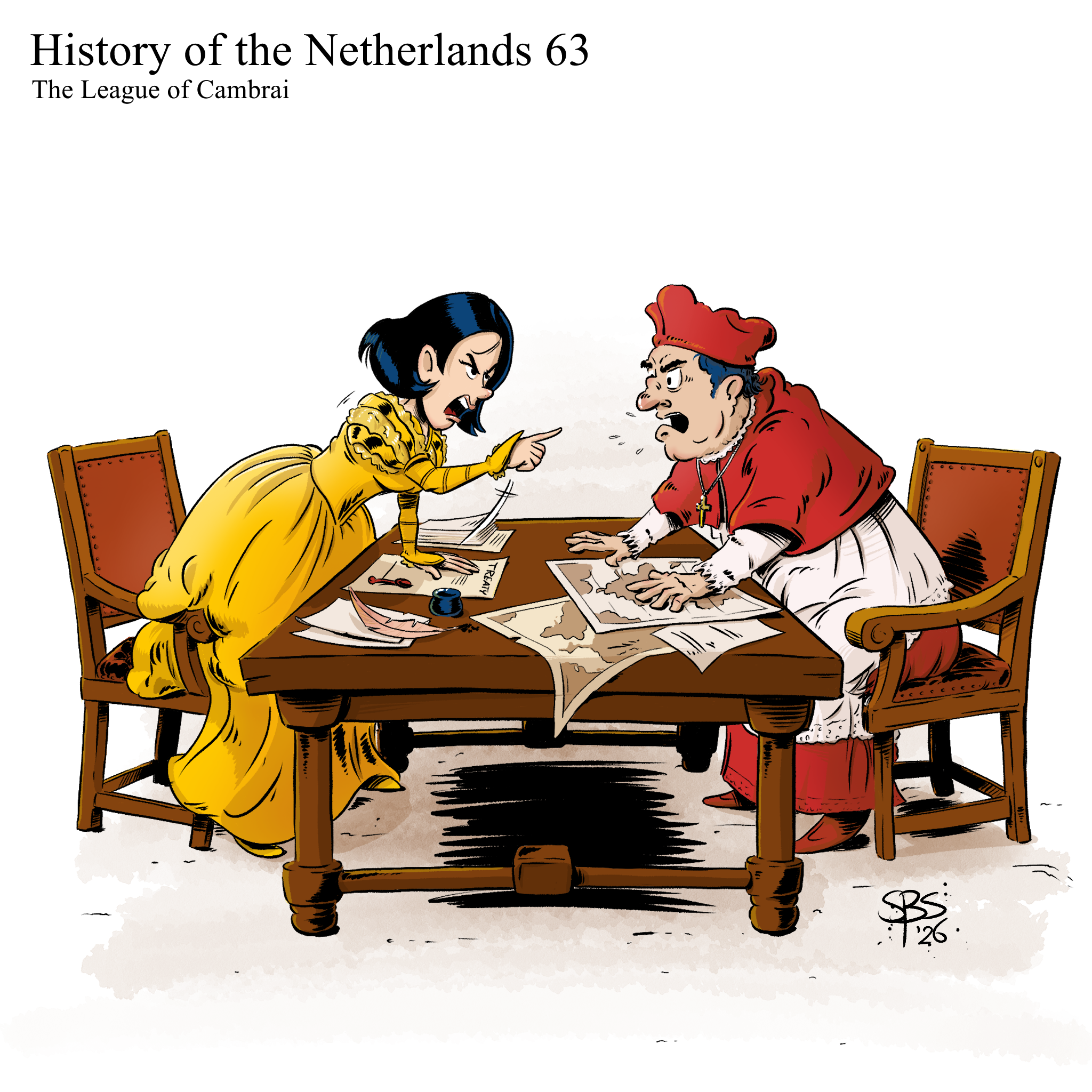
Over two gruelling weeks, the various issues between Maximilian and Louis XII were hashed out between Margaret of Austria and the Cardinal d’Amboise. We are given an insight into Margaret of Austria’s skilled brinksmanship in the negotiations through a letter she wrote to her father in early December. In it, Margaret wrote that matters had been close to settled, only for d’Amboise to suddenly claim that, despite previous assurances to the contrary, the King of Navarre could not be included in the final treaty. Margaret wrote to her father, “I took a firm stand. Bearing in mind that your instructions include the King of Navarre…I declared to the Legate, in no uncertain terms, that I would rather abandon the entire negotiation than see the King of Navarre excluded from the peace. Furthermore, I expressed my dissatisfaction that, with matters so close to a conclusion, everything should now stall over such a trivial point; I therefore resolved to depart as soon as possible, recognizing that time was being wasted and that the whole process was nothing but a sham.” Margaret was not going to let herself get strongarmed by the French cardinal into accepting a watered down version of the peace treaty and was prepared to walk away completely should he insist. In the end, d’Amboise backed down. In another letter which Margaret wrote to her ambassador in England, she said of the two weeks in Cambrai “it often cost us a bad headache, and that monsieur the legate and I were nearly tearing out each other's hair! However, at the end we were reconciled and became the best possible friends.”
It’s a great image which you can easily visualize in your mind, this princess and a cardinal standing over a table, screaming and shouting as they grab at one another’s hair. And speaking of grabbing, that brings us to this episode’s edition of… Bet You Didn’t Know That Was Dutch! The English word “grab” comes from the Middle Dutch word “grabben” or “grabbelen”, which means “to grasp, grab, seize, snatch”. It was first used in this sense apparently in 1486 in a book titled “Het boeck vanden pelgherym”, in the phrase “te grabbelen bider kelen”, meaning literally “to grab by the throat”. So next time you feel like grabbing someone by the throat, or the hair, take a moment to reflect on how you are, in fact, being Dutch. Grabbing! Bet you didn’t know that was Dutch. Now back to Cambrai.
The two resulting treaties of Cambrai
The result of all of these discussions were two treaties, one which was made public in the Cathedral of Cambrai on December 10, 1508, and another which was kept secret. They were agreed to with oaths taken by Margaret of Austria, the Cardinal Georges d’Amboise, as well as ambassadors from the King of Aragon, Ferdinand. According to Italian chronicler Guicciardini, “All the information they thought fit to give the Public on this Head was, that the Pope and every one of the contracting Princes had entered into an Obligation of perpetual Peace and Alliance between themselves”. That’s right, Maximilian, Louis XII and the Pope were to be life-long allies, ostensibly to join forces against the Turks. The main points of the first, public, treaty were essentially a rehashing of the Treaty of Blois from 1504, except that the previously agreed upon betrothal between Maximilian’s grandson Charles, and the French King Louis XII’s daughter Claude, was to be officially cancelled (Louis had already broken this anyway in 1506 when he agreed for Claude to be married to his cousin Francis, who was Louis’s heir presumptive given he did not have a son). Maximilian agreed to reinvest Louis XII in his position as Duke of Milan in return for 100 thousand crowns.
Most relevantly for us, since we are, of course, the History of the Netherlands podcast (in case you had forgotten), was that a one year armistice was declared between Maximilian and Charles of Egmont in Guelders, with Charles to return the castle of Muiden and the town of Weesp in Holland, to which he had no real legitimate claim. This was the peace treaty which we referenced as the end of Episode 61, when we were on our latest imaginative journey through Amsterdam. As to the castles and towns which had been conquered within Guelders itself, to which both sides had claims, it was agreed that they would remain in the possession of whoever presently controlled them, until this could be settled in arbitration with the Emperor, the King of France, the King of England and the King of Scotland. On the 24th of January, 1509, Weesp and Muiden were officially returned to representatives of Maximilian and the young Archduke Charles. Unfortunately, however, this truce would only prove to be temporary and hostilities within Guelders would begin anew later.
The most widely impactful substance of the negotiations at Cambrai, however, was to be found in the second, secret treaty, in which Maximilian, Louis XII, Ferdinand of Aragon and the Pope mutually agreed to partition the terraferma holdings of Venice between them. We saw in the previous episode how Venice had extended itself across the Italian mainland over recent decades, much to the chagrin of the Pope, the French, the Aragonese and the Emperor. Well now, those powerful princes were to join forces and take back what they saw as rightfully theirs. The preamble of the treaty justifies this by saying that by occupying Papal lands, the Venetians had been harming Christianity and the Church, and that “the insatiable greed of the Venetians and their lust for dominion—which act like a spreading conflagration—be finally extinguished; and that, by joining our forces and arms, the goods seized and occupied by these same Venetians may be recovered and restored.” Never mind that the terms “insatiable greed” and “lust for dominion” could easily be applied to behaviour and intent of each and every one of those princes towards Italy over the same time period.
The text of the treaty explicitly lays out how the territories of Venice were to be divided. The Pope was to receive the towns of Faenza, Rimini, Ravenna, and Cervia, Louis XII was to take the towns of Ghiaradadda, Bescia, Bergamo and Crema which had once belonged to the Duchy of Milan, Ferdinand of Aragon was to regain control of the port towns in Apuglia which had belonged to Naples, whilst Maximilian was to take back Padua, Vicenza, Verona, Friuli and Trevigi, all of which had either been part of the Imperial domains or the House of Austria. Of course, this completely flew in the face of the previous three year peace treaty which Maximilian had just signed with the Venetians earlier in the year. The beauty of now aligning himself with the Pope, however, was that Julius II could excommunicate Venice and its subjects, thereby freeing Maximilian from the bounds of that previous treaty and demand his assistance as Protector of the Church. The war on Venice was to begin with an attack by Louis XII on April 1 the following year, after which the others would join in within 40 days. A bunch of other lords, such as the King of Hungary, the Duke of Savoy and the Duke of Ferrara were also invited to join in. It was essentially going to be a free-for-all buffet at the table of Venice, with everyone taking a slice.
Margaret of Austria’s diplomatic skill at Cambrai had managed to bring the most powerful princes of Europe together into a coalition against Venice. More importantly, however, in so doing she was able to bring about a temporary respite to her subjects in the Low Countries, especially those in Holland and Brabant, who had been bearing the burden of the conflicts between Maximilian and Charles of Egmont for so long. In the words of Jane de Iongh, Margaret had “flung a precious booty to the grasping potentates in order to win time for the consolidation of her own position in the Netherlands, which would only obey a ruler who brought them peace”. This was a triumph for the relatively new regent and she was rewarded when the States voted to give her 60000 pounds for bringing an end to the war. Margaret of Austria had proven herself capable of standing up to the most powerful and wily power brokers in Europe and had passed her first real examination on the international stage with flying colours.
The Battle of Agnadello
So with Margaret of Austria having played her part, the stage was now set for an all-out attack on Venice by a coalition of the most powerful princes on the European continent. But the War of the League of Cambrai, as it would come to be known, was remarkable not only for the way it brought these princes together, but also for how the perpetual alliance which had been promised between them would fracture. The War of the League of Cambrai would be just the first part of an ongoing conflict which would continue until 1516, in which all the major players would switch allegiances, changing sides when they perceived that their frenemies were growing too strong. The result of it all would be that at the end, the situation in Italy was pretty much exactly how it had been in 1508, except that a lot of blood had been spilled and money had been spent in the process. We do not wish to dwell on Italy for much longer so in this final segment of the podcast we are going to fly through the first part of the war and follow the fortunes of Emperor Maximilian as he sought to get his revenge against the Venetians.
There had been great importance placed on keeping the true nature of the discussions at Cambrai secret from the Venetians, so they would not catch wind of what was concocted against them. Venetian chronicler Peitro Bembo wrote that Louis XII apparently personally reassured the Venetian ambassador that “nothing was negotiating in Cambray against the Venetians”. Nevertheless, word did leak to the Venetians that a coalition was being formed against them. In “Venice and Its Story”, Thomas Okey relates one such tale about how this happened, which can be found in the Venetian State papers, “Spinola, an emissary of Gonsalvo of Cordova, came secretly to Cornaro, the Venetian Ambassador, at Valladolid in February 1509, and asked him to meet the great captain at mass in an unfrequented church at the far end of the town. He went and the secret was revealed to him. He refused to believe it, but later Spinola showed him a copy of a letter from Gonsalvo’s wife at Genoa in which the details of the proposed partition were given”. Another example comes from Italian chronicler Guicciardini, who says that Pope Julius II was “in greater doubt and perplexity” about the treaty. Apparently Julius was not exactly thrilled about the prospect of how a war against Venice might enhance the power of both Maximilian and Louis XII in Italy, so made efforts to gain the territories he desired through diplomacy with the Venetians. Guicciardini writes that Julius “attempted to induce the Venetian Senate to restore to him Rimini and Faenza; representing to them, that the dangers which hung over their heads from the confederacy of so many princes would be greatly increased by his accession to the League, as he could not then refuse to persecute them both with spiritual and temporal arms,” and then went on to suggest that if he didn’t join, the League would quickly fall apart without him. But despite the warnings, the Venetians refused to hand over the towns and Pope Julius eventually ratified the treaty in March, 1509.
Now aware of the coming attack, the Venetians did whatever they could to bring together an army for their defense. They used their financial might to whip up an army of 1650 men-at-arms and 22000 infantry, who were to be led by the two commanders who had resisted Maximilian’s invasion a year earlier, Niccolo Orsini da Pitigliano and Bartolomeo d’Alviano. They were shrewd enough to realise that Maximilian, Ferdinand and the Pope were not in any position yet to attack them so they focused their efforts on defending their frontier with the French in Milan. The French King Louis XII, meanwhile, was also not particularly certain of the intentions of his allies, so had made sure to enlist a large enough army so as to not need to rely on them. In their book The Italian Wars, Christine Shaw and Michael Mallet write “Louis would be going to Italy in greater strength than any French king had gone before, Cardinal d’Amboise affirmed; he would be strong enough to oppose Maximilian as well, if he did not stand by his promises. He could beat the Venetians, Maximilian and the pope combined, Louis himself asserted.” In the middle of April 1509, the French officially declared war on Venice, on April 27 Pope Julius II excommunicated all of Venice, and on May 1, French King Louis XII entered Milan to begin the attack, with 2300 lances and 20000 infantry, of which 6000 were Swiss mercenaries.
The decisive early battle would come on May 14, 1509, when the French army engaged the Venetian rearguard near a place called Agnadello. The Venetian commanders, Pitigliano and d’Alviano had disagreed on what their best strategy against the French should be. The Venetian senate had ordered them to avoid fighting the French and to slow their advance as much as possible, which Pitigliano was resolved to follow, whereas d’Alviano had wanted to attack. The Venetian army had been moving camp and were spread across a 4 mile stretch of land when the French suddenly attacked their rear. d’Alviano, who was in charge of the rear, sent a message to Pitigliano that he required his assistance engaging the French, but instead Pitigliano simply sent back a note saying that d’Alviano should avoid battle and to continue marching. Well, d’Alviano was having none of that and over the next three hours fought valiantly, but in vain, against the French. The result was an absolutely crushing defeat for Venice. Roughly 4000 of d’Alviano’s troops were killed, including several important commanders, 30 pieces of artillery were captured, and d’Alviano himself was severely injured and taken prisoner “having one of his eyes almost beat out, and his whole face much bruised.” The catastrophic defeat saw the Venetian army disintegrate overnight due to mutiny and desertion, with what was left returning to a place called Mestre on the Venetian lagoon to prepare the defence of the city of Venice itself. Louis XII captured Bergamo and Brescia and occupied a huge chunk of Lombardy, spectacularly achieving his war aims in just two weeks. Machiavelli would later write of this that “Venice lost in one day all that she had won in eight hundred years”.
In the face of this dramatic defeat at Agnadello, the Venetians saw their terraferma holdings rapidly slipping from their grasp. Understanding the imminent peril they now faced, the Venetian senate made a calculated decision to let go of their holdings on the mainland, releasing their subjects from their oaths of allegiance to them. Guicciardini writes of this “they resolved to lessen the number of their enemies and… abandon the defence of the terra firma, that the King of France might have no inducement to advance towards their capital, where they were not without apprehension of an insurrection, either of the populace, or of the innumerable multitude of foreigners living in Venice, to which they might be tempted by a greedy desire of plunder”. The port towns in Apuglia were given up to Ferdinand of Aragon and the towns in the Romagna were handed over to the Pope. Maximilian, however, was nowhere to be seen.
The Emperor had been unable to drum up support in the Empire for yet another invasion of Italy. Thomas Dyer writes that at the Diet of Worms in April, 1509, Maximilian had been rebuffed by his Estates, “to whom he submitted the plan of the League and demanded their support. This, however, was not only refused by the diet, but they even accompanied their refusal with reproaches and complaints…[Maximilian] found himself compelled to resort to his hereditary dominions in order to levy an army.” Christine Shaw and Michael Mallet write that “Verona, Vicenza and Padua were prepared to acknowledge Maximilian, but there were no Imperial troops near to whom they could surrender.” A small force of Imperial troops entered into Venetian territory on June 1, 1509, where they began reclaiming that which had been lost in the war a year earlier. Trieste and Gorizia were taken by Imperial forces, and on June 5 the gates of Padua were opened up to Imperial troops. A meagre force of perhaps 800 troops occupied Padua. Maximilian himself, however, would remain Trent until the beginning of August.
The Siege of Padua
It was the town of Padua that would become the focal point of the war in Italy for Maximilian and his army. The Venetian strategy of pulling their armies out of the terrafirma had worked, in that it had halted the advances of the rampaging French army. Louis XII had managed to occupy all that was his under the terms of the League of Cambrai and was careful not to overstep the terms of the treaty for fear of putting his allies off-side. The French king headed back to Milan in triumph on July 1, after which he returned to France and most of his army was disbanded. The Venetians realised that Maximilian had not placed sufficient troops in defence of Padua and were also aware that many of the common people of that town preferred Venetian rule. As such, they sensed that the time was ripe for a counter attack and on July 17, 1509, a Venetian army led by Andrea Gritti was able to quickly retake Padua by surprise, with the Imperial troops that were present quickly surrendering. In the aftermath, the area around the town of Padua also rallied back to the Venetians side. The Venetians were able to bring together a large army to come to the defense of Padua, with Christine Shaw and Michael Mallett estimating their forces to consist of 14000 infantry, 500 men-at-arms, 600 mounted crossbowmen and 950 stradiots, who were placed under the command of Niccolo Pitigliano. A large number of Venetian young noblemen apparently also headed towards Padua, which Gucciardini says raised the morale of that town in the face of an inevitable counter attack by Imperial forces.
After months of dilly-dallying, Maximilian had finally been able to raise a sufficient number of troops for his army by early August. The loss of Padua seems to have made him realise that he could no longer delay entering into Italy himself, so he departed from Trent and headed south towards Padua, intent on restoring his blemished honour and retaking that town. Maximilian’s army is estimated to have begun its march into Italy at perhaps up to 60000 men strong, including contingents of French, Spanish, Ferrarese, Mantuan and Papal troops, as well as 200 cannons, though by the time he had reached Padua in mid-September that number had dwindled to around 15000-20000. The siege began on September 15, 1509, with Gucciardini writing of it “after wasting a deal of time and giving leisure to the enemy to fortify themselves, and lay in stores of provisions, Maximilian opened the siege before Padua and erected his batteries against the gate of Portello. Not in this age, nor perhaps in many ages, had Italy ever seen a siege that drew the attention, or raised the expectations of the public to so high a degree, both on the account of the nobleness of that city, and the importance of the events that depended on its loss or preservation”. The eyes of the world were on Padua, waiting to see whether or not it would be able to withstand the coming onslaught from Maximilian.
Over a period of around two weeks, the Imperial artillery opened fire on the massive fortifications of Padua. Maximilian is said to have personally and bravely commanded the attack, micromanaging affairs to ensure that the cannons were properly positioned and put together. The Venetians had cleverly constructed earthen bastions which were connected to the walls, which themselves were surrounded by a ditch filled with water, and then placed artillery in the bastions so that they could return fire upon the Imperial troops. In addition to this, they had buried barrels of gunpowder underneath the bastions so that if they were captured they could be blown to smithereens. On day five of the siege, a small assault was carried out by French and Imperial troops on one of the gates, but was quickly repulsed. Guicciardini writes that “on the ninth day of the siege, the artillery had done such execution, and the breaches were so wide, that it was thought unnecessary to continue firing from the batteries”. Plans were made for a large scale attack. Imperial troops were able to divert the water supply so that they could drain the ditch, after which 7500 landsknechts are said to have attacked the Codalunga gate. Imperial troops were able to capture a bastion and raise their flags upon it, only for Venetian defenders to blow up the gunpowder hidden underneath it. Thomas Dyer writes that “a great part of the [imperial troops] were hurled into the air, and the remainder, in this moment of consternation, were charged by the Venetians, and driven from every post”. Maximilian once again faced disaster in Italy. He had lost a large portion of his fighting force and disagreements arose between his forces and French forces, who were keen to depart. By the beginning of October, Maximilian had again run out of money with which to pay his troops and was forced to give up the siege of Padua. It was, once more, a humiliation for the Emperor, who quickly disbanded his army and left for Tyrol. In the wake of his departure, Venetian troops were able to take the town of Vicenza, but were unable to regain Verona due to French troops which were stationed there.
Not long after the failure of the siege of Padua, the League of Cambrai fell apart. In early 1510, Pope Julius would abandon the alliances he had made and instead actually side with Venice against France, having decided that the biggest threat in Italy now was Louis XII. Maximilian’s involvement in Italy would become much curtailed, relying entirely on financial support from Louis XII to do anything. The Emperor wouldn’t make any large scale invasion into Italy again until 1516. We do not wish to stay in Italy for much longer, having spent the majority of the last two episodes there. So, you might be asking, why on earth have we delved so much into goings-on taking place in a region so far from the locus of this podcast’s…focus? Firstly, as always, we want to impress how the history of different European nations can not be disentangled from one another, since the modern notion of ‘nations’ is much more recent than the events which we have been covering. It is impossible to tell the ‘history of the Netherlands’ in a vacuum that disregards the dynastic powerplays of the composite monarchies that had developed across Western Europe by the 16th century, the tentacles of which reached all over the continent and beyond. Secondly, we have spent much time in this podcast following the life of Margaret of Austria. In this episode we got to see how she first implemented the value of her life’s experiences on the wider political stage; namely in negotiating the terms that led to the League of Cambrai. As we go forward in time, Margaret’s legacy will linger in the governmental style of the Low Countries (not least through the successive two other women (being Mary of Hungary, the sister of Charles V and then Margaret of Parma, his illegitimate daughter) who, along with Margaret of Austria, will determine much of Low Country policy for the next six decades. Without the context of the Italian Wars it would be meaningless to convey how Margaret fashioned international diplomacy in an effort to placate the discontent of her subjects in the midst of the Guelderian war. In removing the deprivations of war from her lands, she seemed to have learned what her male forebears had not. Lastly, and as we mentioned briefly in the previous episode, the travails of the Venetian Republic in the face of monarchical dominion provide us with some pretty neat foreshadowing as to what lies ahead for the Netherlands once it, too, becomes its own republic in the 17th century. But that, of course, as well as much more, is all for future episodes of History of the Netherlands (most of which, we promise, will actually be based in the Netherlands.)
Sources used:
“Discovery of an Early Sixteenth-Century Battle Plan from the Archdiocesan Archive in Ljubljana” by Tomaž Lazar, in Journal of Medieval Military History, Volume XX (June 17, 2022)
Maximilian I, Holy Roman Emperor by R. W. Seton-Watson
The History of Italy Vol 4 by Francesco Guicciardini
The Italian Wars 1494–1559: War, State and Society in Early Modern Europe by Christine Shaw and Michael Mallett (Routledge, 2019),
The high and puissant princess Marguerite of Austria, princess dowager of Spain, duchess dowager of Savoy, regent of the Netherlands by Marian Andrews (pen-name Christopher Hare)
“Postojnski grad v letu 1508 in Maksimilijan I. z vzdevkom »Leviades«” by Primož Simoniti in Zgodovinski časopis, Volume 64, Issue 1-2 (2010).
Correspondance de l'empereur Maximilien Ier et de Marguerite d'Autriche ... de 1507 à 1519 by M. Le Glay, Tome 1
Margaret of Austria: Regent of the Netherlands by Jane de longh
Corps Universel Diplomatique du Droit des Gens by J. Du Mont, Tome IV, Part 1
Women who would be kings : female rulers of the sixteenth century by Lisa Hopkins
Venice and its story by T. Okey
The Prince by Niccolo Machiavelli
A History of Modern Europe From The Fall of Constantinople to the War of Crimea AD 1453-1900 Volume 1 by Thomas Henry Dyer