
Episode 62: We Do It Like The Italian Job
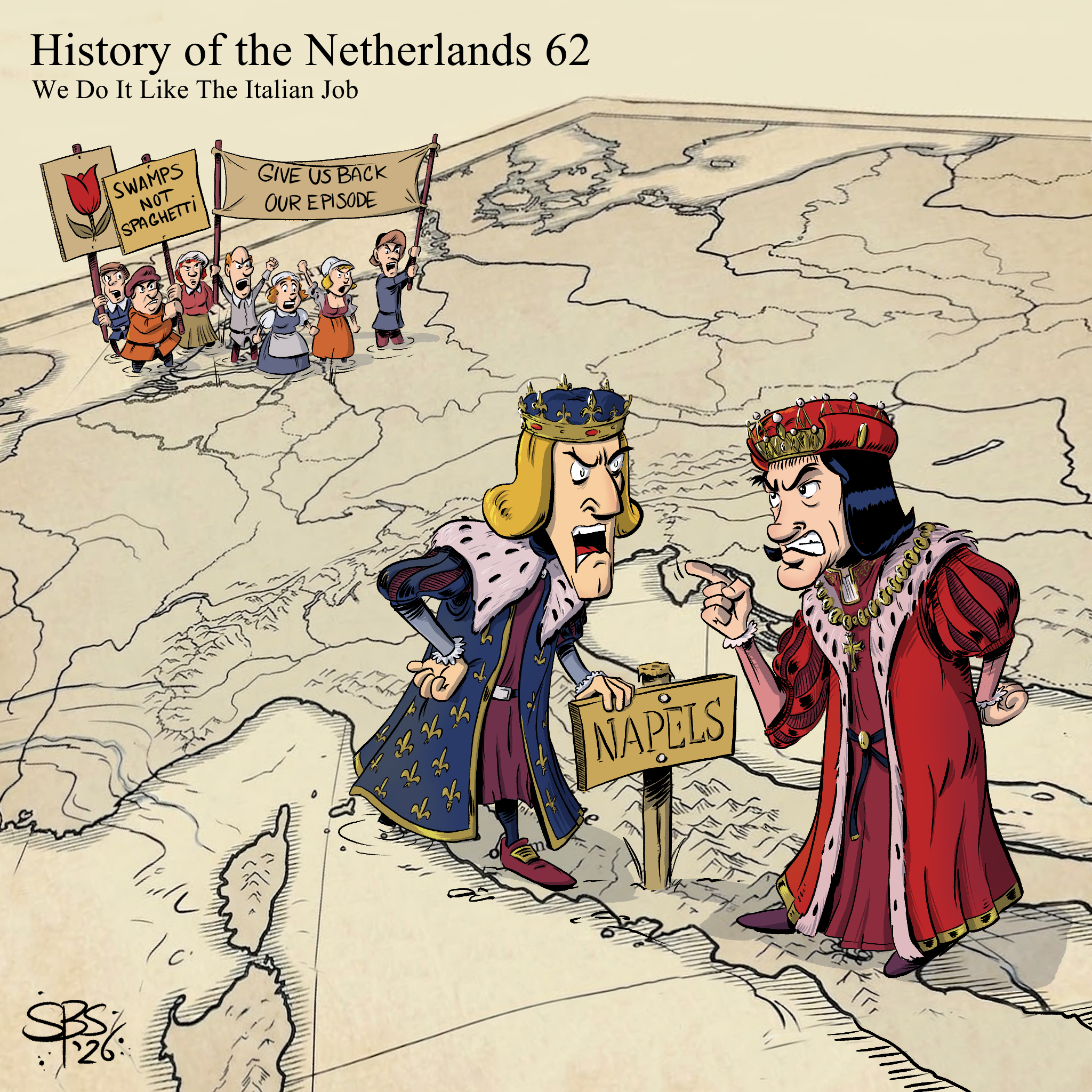
“We Do It Like The Italian Job” episode artwork by Steven Straatemans
Margaret of Austria’s ability to fight the war with Guelders in 1508 was hampered by events involving her father Maximilian on the other side of the Alps in Italy. The balance of power in Italy had been disrupted in 1499 when French King Louis XII had led an invasion into Milan. Over the next few years the biggest players on the European chess-board, such as Louis XII, Aragonese King Ferdinand, Maximilian and a couple of Popes, would duke it out across Italy in a series of conflicts that would become known as the Second and Third Italian wars. The players would variously join forces, switch sides and do whatever it took to enhance their own positions, especially in the Kingdom of Naples, and in the end they would somehow all end up with one common enemy: Venice. Our intention in this episode is to give more detailed context to these wars so that, in the next episode, we can tie it all together with the diplomatic stylings of Margaret as she wove together an unlikely alliance to go lay the smack down on the most serene republic.
Living in the shadow of Maximilian
Margaret of Austria’s ability to effectively rule in the Low Countries, a task which we have seen time and time again was already difficult in the best of circumstances, was made all the more challenging by the fact that her father, Maximilian, was constantly requesting her support in his many and varied schemes. As we will talk about later in this episode, at the point we are at in our chronology through Dutch history, the year 1508, this meant helping Maximilian to head off once again to Italy, this time to go to war with Venice as part of his long standing dream to get to Rome to be finally be officially coronated as Emperor by the Pope. Maximilian had been the de facto Emperor since his father’s death in 1493, but he still needed the fancy ceremony in Rome before he could really officially call himself Emperor. He knew all too well that the title sounded better than the reality. In 1497, he had wisely told members of his council, or Diet, that “the empire is a heavy burden, with little gain therefrom.” But still, being crowned emperor in Rome was, in the words of historian Christine Shaw, “connected in his imagination to his dream of leading a crusade against the Turks.” As another historian, Marian Andrews wrote: “He was always full of splendid dreams—the destruction of the Turk, the conquest of Italy, the absolute supremacy of the House of Austria ; but almost before any plan became definite, he had passed on to another no less wild and unattainable.” Maximilian was distracted from his distractions by other distractions (from which he would eventually be… distracted) and all of these distractions cost money.
What this meant for the Netherlands and its Guelderian situation was that his lieutenant regent, Margaret, was left to scramble looking for money to pay soldiers fighting on his behalf against Charles of Egmont. She also had to deal with her father’s frequent orders to send him money for his ventures, which she was supposed to extract from her subjects in the Low Countries. Alongside this was her guardianship of her nieces and nephew, which made her responsible for negotiating a marriage agreement between her nephew and heir to everything, Charles, and Mary, the daughter of the crown Prince of England, Henry, soon to become Henry VIII. If you are thinking, is it that Mary then yes, it is that Mary, whose mother was Catherine of Aragon and who, in the future, would become the queen known in some circles as ‘Bloody Mary’. Anyway, getting way ahead of ourselves there.
Immediately upon her taking on the regency in the first half of 1507, Margaret and Charles went on a tour through Flanders, reinstating the privileges of the towns and cities of that province. She sent an ambassador to the French king to pay homage on her behalf, for the territories of Charolais and Burgundy. Her ambassador returned having succeeded in his mission, but related to the Archduchess that “I tendered your homage to the King and kissed him on your behalf, and he replied once more that he would have much preferred to kiss you rather than me.” While this might seem to reinforce that Margaret, whilst trying to provide stable government for her subjects, always had to contend with the fact that her contemporary rulers saw her first as a woman, and second as a ruler in her own right, it is probably more exemplary of her interpersonal abilities as a diplomat, nurtured by her vast experience and capacity for maintaining good relations. Her chronicler Jean Le Maire puts enormous value in everything she had learned in life thus far. “'Madame Margaret has seen and experienced more at her youthful age . . . than any lady on record, however long her life.” Regarding her communications with the French monarch, Margaret had to overcome her personal hatred of the French court which had been forged in the treatment she had received as a child when her marriage to the previous king, Charles VIII, had been dissolved. That marriage had been annulled in favour of Anne of Brittany and Margaret had been packed up and sent home, permanently dashing the future she had been raised to inherit. Whether she was able to temper her own feelings because of a lingering personal attachment to the now French king, Louis XII, or out of diplomatic necessity is uncertain. Eleanor Tremayne tells us that “Margaret also kept ostensibly on the most friendly terms with Louis XII, whose correspondence with her about this time shows that, to him at least, she concealed her hatred of France. In each of his letters he takes a pleasure in reminding her of their early friendship and of their childish games, in the days when she was ' la petite Reine ' at Amboise.” It was this unique standing amidst the main monarchs of western Europe that would prove invaluable in creating an unlikely international arrangement following major developments in Italy which we will talk about in the coming episodes.
Before we get into the matters that would be in contention for Margaret and all these monarchs during 1507 and 1508, there is another thing we want to make mention of here, with little to no context. That is that, even though we farewelled him as a source back in episode 58, we can now farewell Jean Molinet for good as a living person since, around this time in August 1507, he quivered off his ephemeral spring while enjoying his old age in the town of Valenciennes. He had spent the last 5 or so years there holding down the position of deacon at the church of Notre Dame. I don’t want to belabour the point, since we already paid homage to him. I just want to say the words: Vale Molinet.
The war in Guelders and the lack of money
So in order to facilitate her father’s fickle and frequently fluctuating financial foibles, Margaret pressed for aides from the Burgundian Low Country estates. On July 20, 1507, she requested from the estates the ratification of a so-called Phillipus gulden, which was to be a coin tax on every household - sometimes also called a hearth-tax. The proposed Phillipus Gulden was named after her late brother, and it was to be used to pay for the Burgundian military defence against the Guelderians. However, as historian Helmut Koenigsberger wrote in his tome Monarchies, Parliaments and States-Generals, “The uncertainty about the true centre of decision-making between Margaret's government and the constantly journeying Maximilian also made Netherlands defence policy and the resources which needed to be devoted to it uncertain. As a result the government was nearly always on the defensive in its relations with the States General.” Although there was nothing novel about this sort of tax, in this situation there was an exception to the norm, in that it was requested of everybody, and not just the third estate. Unlike many taxes, it did not include the usual exemptions given to the bigwigs in the aristocracy, government and clergy. Perhaps this is why it was rebuffed by the States-General and, in its stead, a flat aide of 200,000 florins was granted; an amount that Koenigsberger calls ‘modest’.
We have touched upon the lack of funds needed to properly defend against Guelderian forces in previous episodes, but it is worth giving an example of how this had real-world implications in the theatres of the war. The Guelderian castle of Poederoyen, whose strategic location on the borders of both Brabant and Holland made it invaluable for whomever controlled it in the conduct of the war, had been seized by loyalists of Charles of Egmont in 1493, which we mentioned way back in Episode 47. Now, nearly 15 years later, in July 1507, the Burgundian government sent men from the Holland towns of Gouda, Dordrecht and Gorinchem and the Brabant town of ‘s-Hertogenbosch together with about 400 mercenaries, to put Poederoyen to siege. All of this was under the command of Margaret’s chief captain, Jan of Egmont, who was a relation of Charles of Egmont but very much not one of his supporters. The Guelderian defenders in Poederoyen were led by a man called Henri Ens, but who had an absolutely sick nickname which was, depending on which source you believe, either ‘Suydewint’ - the southwind, or ‘sneeuwind - snow-wind. Both of them would be nicknames of which a patreon-sponsor would be proud. Old South-wind was, in the words of Marian Andrews in another of her books Maximilian the Dreamer: “more than a match both in craft and valour for the besiegers.” Even after the Burgundian troops blocked the city off from anything going in or out and built a blockhouse before it, he deftly defied all their attempts to seize it. He and his fighters held on long enough for their attackers to get the willies when erroneous rumours abounded that Charles of Egmont was about to relieve them two months into the siege. The siege broke hastily in September due to these rumours and some reports had the men from Holland fleeing in a manner that has been called “cowardly”. In their description of it today, the Historic Association of Old Leiden have on their website words written by Historian Tim Bisschops of Antwerp University, saying “it was an inglorious episode that left a significant stain on the reputation of Holland in particular.” Margaret, upon hearing of this news, wrote in irritation to her captain Jan of Egmont “It is true that misfortunes must be suffered, but it seems to me that we suffer many more through our own fault than through divine will.” In other words, ‘not happy, Jan!’.
Thereafter, in March 1508, the States of Holland and of ‘s-Hertogenbosch came to a deal with one of Maximilian’s close friends and advisors, who was recommended to them by Margaret. This was a guy called Rudolph IV of Anhalt-Dessau, aka Rudolph the Brave, Prince of Anhalt. A noble veteran of high repute, he was given funding which this time had to be shared by Hollandic towns that had been standing on the sidelines until now, being Haarlem, Delft, Leiden and Amsterdam. For keen listeners of our most recent episode, this was at the same time that Amsterdammers were being prepared for an imminent Guelderian attack on their city. A cultural-historical centre in Leiden called Erfgoed Leiden en Omstreken has a contemporary document from 1508 that details a forced loan levied on 290 households in Leiden - mainly of the city’s wealthy elite - to the total of around 770 Flemish pounds, a chunk of which was to be used in the capture of Poederoyen by Rudolph the Brave. In this endeavour he was helped by the fact that the South-wind, Henri Ens, perished when a falling beam crushed him to death. As such, in June 1508, Poederoyen finally fell to Margaret’s forces.
While this was a significant victory for the government, it did not solve the problem of money. Garrisons in other towns, such as Tiel, Arnhem and Breda were at this time facing starvation and exposure for lack of funds. In December 1507, the shivering garrison of Tiel implored Margaret for money, via one of her chief advisors, Anton de Lalaing. While we cannot locate a digitized version of this letter, it can apparently be found in the archives of Department du Nord in Lille, France, the uncovering of which was one test too many for our patience. Both Andrews and Dutch historian L.M.G. Kooperberg cite this letter and Andrews takes it to say that they (the garrison) “have no coat or doublet or shirt on their backs, and have nothing to eat. If they have cloth sent them from [‘s Hertogenbosch] to clothe those who are naked, and payment for a fortnight, they will have patience a little longer, otherwise they will be forced to give up the town from poverty.” Margaret had already received other such letters, all basically saying the same thing, from Rudolph the Brave before Poederoyen, from Henry of Nassau about the men at Breda, and another from one of her generals at Arnhem, Florent of Egmont, who wrote: “Madame. . . . the captains have been to me and have told me finally and firmly that they cannot hold out, and that they are in such great necessity and have suffered so much that if within fourteen days money is not sent to them they will leave the town . . . but I do not know where to find, by credit or otherwise, even a hundred florins . . . and I am assured that at the end of the month, of which there only remain eight or ten days, for want of pay they will abandon the city.”
Obviously this situation was terrible for the morale of the fighting men, but it did nothing to sustain the morale of the general populace either. In the garrisoned towns, citizens had to provide for the soldiers, with no guarantee of being reimbursed. Furthermore, if and when soldiers were not provided for, particularly the foreign mercenaries, it left them unhinged and liable to go and ravish the countryside, unleashing horrible deprivations upon ordinary folk as they pillaged and plundered. This was known as “manger le bonhomme”, which I guess you would translate as ‘eating the good folk.’ As for Charles of Egmont, Margaret’s opponent in all of this, he seemingly did not have such problems. Waging a guerrilla war for the defence of a homeland, he could rely more on his fighters’ loyalty to a cause that was tied to their families, companions and their sense of ‘home’, which sustained their righteousness against a perceived oppressor. He also had mercenaries to sustain, but his ability to exploit political divisions in Groningen, Friesland and the bishopric of Utrecht allowed his mercenaries to ‘eat the good folk’ of Holland and Brabant, instead of those in Guelders (as we explored in our previous episode). While the international wranglings in which her father was mired would now demand her attention, this situation on the domestic front did not stop and continued to mount pressure on her and her wallet, which would all eventually come to bear in a few years' time when her ward and nephew, Charles, would come of age. We will, of course, come to that in future episodes, but we felt it was important to give it space before we zoomed out to see what was happening in Italy, since that would also come to bear on events in the Netherlands. Zooming out is what we are going to do, right after we zoom through this short break.
Time for another trip to Italy
Although the war with Guelders is of immediate interest to us, given the Netherlands focus of this podcast, it was just one tiny patch in the tapestry of tumult of which early 16th-century European politics comprised. As we are already well aware, Maximilian was involved in a back-and-forth tussle between the other heavy weight European leaders of the age, being the English King Henry VII (aka Henry Tudor), the French King Louis XII, King Ferdinand of Aragon, plus whoever happened to be the Pope at any particular point in time. When these monarchs weren’t clashing with each other in the Low Countries, you can be almost certain that they were at each other’s throats on the other side of the Alps in Italy, which hosted a series of wars throughout the first half of the 16th century, creatively dubbed by historians as “The Italian Wars”. We spoke about the first of these in Episode 48, when we saw a conglomeration of rulers come together in the so-called Holy League to force French King Charles VIII out of Italy after he had invaded Naples in 1494/95. In this part of the podcast, we are going to un-do a fair whack of work we have managed lately in pushing this podcast slowly forward in time, and head down to Italy to explore what has been going on there since the turn of the century and what influence our players in the Netherlands will have to bear on it all. It’s time for another installment of la storia dei Paesi Bassi. Welcome to History of the Netherlands: the Italian Job.
Louis XII’s take over of Milan
The second phase of the Italian wars has been tangentially referenced at several points in the last few episodes but since they didn’t directly impact the Low Countries we didn’t (and still won’t) go into huge detail about them, but they basically concern the Duchy of Milan, the Kingdom of Naples and the Republic of Venice, the latter of which is where events will tie in our beleaguered Regentess in the Netherlands in episodes to come. But to get there…we need to go here:
After becoming the King of France in 1498, Louis XII asserted his claim to the Duchy of Milan through his paternal grandmother Valentina Visconti, who was the daughter of the first Duke of Milan. Milan was an imperial fief and had been ruled by Ludovico Sforza since 1494. We last saw Ludovico in Episode 56 during Maximilian’s attempt to attack the Florentines at Livorno in 1496. He was the one who probably poisoned his nephew, Gian Galleazo Sforza, for whom he had been ruling as regent in Milan. He was also the guy who changed his second son’s name from Ercole to Massimiliano in honour of Maximilian, which is still objectively funny. During the First Italian War of 1494-95, which we explored in episode 48, Louis, who was then still just the Duke of Orleans, had suffered a humiliating defeat at the hands of Ludovico’s wife Beatrice at the Siege of Novara when he had first attempted to take control of Milan. After that, Beatrice unfortunately died in childbirth at the beginning of 1497, plunging Ludovico into a deep mourning. Without her by his side, Ludovico was unable to halt Louis’ next effort to take over Milan. Having by then taken the crown of France as Louis XII, he made a secret deal with the so-called Serene Republic of Venice called, you’ll never guess, the Treaty of Blois, to jointly capture Milan. In August 1499 the Duchy was attacked on two sides and by September, Ludovico and his family had fled, heading for refuge with Maximilian. Louis XII entered the city of Milan triumphantly on October 6, 1499, accompanied by Cesare Borgia, the illegitimate son of Pope Alexander VI, whom Louis had given a made-up ducal title to in return for the Pope annulling his marriage with Joan the Lame - we mentioned that in episode 54. Ludovico was able to raise an army of German and Swiss mercenaries with the help of Maximilian, who helped him briefly retake Milan in February 1500. In April, however, he was captured by Louis’ XII’s troops and would languish in French captivity until his death 8 years later. Louis XII promptly added ‘Duke of Milan’ to his list of titles for the next 12 years, though he left his trusted advisor Cardinal Georges d’Amboise to organise affairs there.
France and Aragon split Naples up like a pizza
With the French takeover of the Duchy of Milan complete, Louis XII’s eyes turned further south down the Italian peninsula towards the Kingdom of Naples, which had been the objective of his predecessor Charles VIII’s unsuccessful Italian adventure five years earlier. Naples had been conquered 50 years before these events by the King of Aragon, Alfonso V. Upon Alfonso’s death the crown of Naples went to his illegitimate son, meaning the dynasty which ruled in Naples was an off-shoot of the Aragonese ruling family, the house of Trastamara. You might remember from Episode 48 that Charles VIII had distant claims to Naples after inheriting the Anjou claim to the Kingdom from his father. He successfully captured Naples and had himself crowned king there in February, 1495, but his troops were unable to hold onto it after he left in May of that year. The Trastamaran King whom Charles VIII had deposed, Ferdinando, was able to return triumphantly to Naples in July, 1495, with the help of his distant cousin who, confusingly for our purposes, shared basically the same name but with whom we are familiar, Ferdinand of Aragon. Ferdinando died shortly thereafter in September 1496 without an heir (probably because he had married his father’s half-sister) and was succeeded by his uncle, Federigo. Ferdinand of Aragon, however, did not support Federigo’s ascension to the Neapolitan Crown, claiming to be rightful heir to his uncle Alfonso, the one who had conquered Naples all those decades earlier. If you are feeling that this is all very complicated, then you are being a brilliant listener, because it is. So, give yourself a little tummy tickle and stick with us. When Louis XII became King of France after his predecessor’s death-by-door-frame, he naturally decided that Charles VIII’s distant claims to Naples now belonged to him, so he began plotting to take it over. The problem was, however, how to do this without incurring the wrath of his powerful enemy, Ferdinand of Aragon?
Well, the answer to this was one that would surprise many. In October 1500 at Chambord and November 1500 at Granada, Louis XII and Ferdinand of Aragon ratified a secret treaty in which the two powerful monarchs agreed to split Naples up between them. Ding ding ding, what’s that? Bet you didn’t know that was Dutch? When we’re talking about France and Spain splitting up Naples? Yes that’s right, unexpectedly now is the time for your favourite section of this podcast. The English word ‘split’ comes from the Middle Dutch word ‘splitten’, meaning, to divide or cleave or to break apart along the grain. It originally entered the English language in the 16th century through, you’ll never guess, the maritime world, where it was used by sailors to describe a ship or a sail breaking apart under strain. So there you go, split! Bet you didn’t know that was Dutch. Back to Naples. According to the details of this treaty to split Naples between France and Spain, Louis XII would become King of Naples and take control of the northern parts of the kingdom, including the city of Naples itself, as well as Terra di Lavoro and the Abruzzi. Ferdinand of Aragon would take over the south of the kingdom, including Calabria and Apulia and be granted the title of Duke. This sounds like a pretty magnanimous idea in theory, but it was full of problems from the outset. The epicentre of future contentiousness in this treaty was that two provinces in the middle of the kingdom of Naples, Capitanata and Basilicata, were completely left out of the treaty, with no mention made of them. This meant that a future conflict over them was inevitable. Be that as it may, the treaty was ratified by the Pope, Alexander VI, who officially bestowed upon Louis XII and Ferdinand their new respective titles.
Machiavelli’s thoughts about all of this
This treaty has been perplexing to pretty much everybody who has read it ever since, including perhaps the most famous of all students of Italian politics of this time, Niccolo Machiavelli. Writing a decade or so after these events in his famous treatise The Prince, Machiavelli criticises Louis XII, saying that that he, “wishing to have the kingdom of Naples, divided it with the King of Spain, and where he was the prime arbiter in Italy he takes an associate, so that the ambitious of that country and the malcontents of his own should have somewhere to shelter; and whereas he could have left in the kingdom his own pensioner as king, he drove him out, to put one there who was able to drive him, Louis, out in turn.” In other words, by entitling Ferdinand as Duke of Calabria and Apulia, he also gave succour to the possibility that Ferdinand and other opponents could screw him over in the future. Machievelli goes on… “The wish to acquire is in truth very natural and common, and men always do so when they can, and for this they will be praised not blamed; but when they cannot do so, yet wish to do so by any means, then there is folly and blame. Therefore, if France could have attacked Naples with her own forces she ought to have done so; if she could not, then she ought not to have divided it.” Letting his enemy establish a foothold into Naples was a huge price to pay, especially considering that a future conflict between the two (over those undetermined provinces we mentioned) was more likely than not. While the decision by Louis XII remains baffling, Ferdinand of Aragon’s personal motives are pretty discernible; simply being allowed to continue his foothold in the region meant he probably couldn’t resist the idea of being gifted half the territory he already saw as his own by rights. Officially, the treaty justified the arrangement as an allied defence mechanism against the ever increasing threat from the Ottomans. Ferdinand’s ousted cousin, Federigo, who was contesting him for the throne of Naples, had made desperate attempts to hold onto his Neapolitan Kingdom by asking for support from the Ottoman sultan, which helped Ferdinand in the public reckoning of his reasoning.
The other strong criticism Machiavelli makes of Louis XII’s dealings in Italy at this time is that he gave the Pope, Alexander VI, an opportunity to further his power there by occupying an area known as the Romagna. This is the area north of Tuscany, which stretches from the Adriatic Sea west across the peninsula. It includes towns like Bologna, Ravenna, Parma and Modena. These lands were nominally of the papal-variety, ruled by lords who called themselves vicars but who actually just swanned around with the autonomy of independent princes. The Pope’s intention was that most of these towns and the lands around them should form one complete Duchy of Romagna, with which Alexander’s son, Cesare Borgia would be invested as Duke. The established back-scratching between the Pope and Louis XII continued in this matter, as in 1499 Louis sent troops that the Pope requested, although the Pope had to pay for them, while Louis counted on the Pope’s continued support in his Naples project.
Of course, though, in this Louis XII was just aiding in making one more lord even more powerful, as Cesare Borgia got pretty big for his boots and duly set his eyes on more than what had been agreed upon. He used his borrowed French troops to make threats against Bologna and their ruling family the Bentivoglio, whose protection had been assured by the French king, and Florence which, as a Tuscan city, had not been part of Louis’ agreement with the Borgias to unite the Romagna. Louis warned Cesare Borgia to cease these ambitions, risking a split in the alliance with the Pope and his son. It is this alliance that, with the benefit of a decade or so’s hindsight, Machievelli drew upon as an example to declare his general rule: "That whoever is responsible for another's becoming powerful ruins himself." He tells us directly that Louis XII “was no sooner in Milan than he did the contrary (to good rule) by assisting Pope Alexander to occupy the Romagna. It never occurred to him that by this action he was weakening himself, depriving himself of friends and of those who had thrown themselves into his lap, whilst he aggrandized the Church by adding much temporal power to the spiritual, thus giving it greater authority. And having committed this prime error, he was obliged to follow it up, so much so that, to put an end to the ambition of Alexander, and to prevent his becoming the master of Tuscany, he was himself forced to come into Italy.” He was arguing here that a ruler’s actions must both strengthen his own position and weaken that of others. “And if any one should say: "King Louis yielded the Romagna to Alexander and the kingdom (of Naples) to Spain to avoid war, I answer for the reasons given above that a blunder ought never to be perpetrated to avoid war, because it is not to be avoided, but is only deferred to your disadvantage.” In other words: by trying to avoid conflict now, Louis was making an error, in that a future, worse conflict with a strengthened church was sure to result down the road.
How very Machievellian of him.
In the middle of 1501, Cesare Borgia returned to Rome, while French troops continued to arrive in Italy in preparation for an all-out assault on Naples. Louis expected the Pope and his son to repay the loan of troops for their Romagna campaigns by having Cesare contribute to his Napoli campaign as one of his lieutenants in this offensive. Borgia therefore left Rome again in late June, slowly making his way to Naples to help the French, although in the words of Shaw et al, because of the tensions arisen between him and Louis XII over Bologna and Florence, he was, at that point, “uncertain of his standing with the French.”
As to our standing in following along with this, let’s summarise where we are so far. In June 1501 the French were moving into Neapolitan territories from Rome and Spanish troops were setting out to land in Calabria, in order to take possession of the southern part of the kingdom on behalf of Ferdinand, as per the Granada treaty. Federigo, the contender king of Naples and distant cousin of the Spanish Aragonese king Ferdinand, is pulling further in towards Naples and the north of the kingdom where his meagre troops were mustered and, even though he put out a call for his barons to mobilise, many of them did not. By the end of July Capua had been taken by the French, in a sack that took its place as one of the most horrific events in the course of the wars. Marin Sanuto the younger, a contemporary Venetian who wrote an account of the wars, tells us that Federigo’s representative, who was sent to negotiate the ransoms of nobles captured by the French, was given a tour of the devastated city, many of whose citizens had been slaughtered alongside their defenders. He was told that the city of Naples could expect worse. A day later, when French troops arrived outside the city of Naples, Federigo decided not to take any chances and fled to the island of Ischia without offering any resistance. He was told he would be allowed to stay for six months while coming to terms with Louis XII.
This seemed like a sweet deal for Federigo, but at this point there was a surprising reappearance in Naples of somebody whom we have spent a great deal of time talking about in previous episodes of this podcast… Philip of Cleves, the Lord of Ravenstein! Yes, Philip of Cleves, who had subbed himself in as hostage for Maximilian at Bruges all those years ago and then led the Flemish revolt against him until eventually surrendering in Sluis in 1492. Philip had entered the service of Louis XII and was appointed as Governor of Genoa, Captain-General of the French fleet and Admiral of Naples. A few days after Naples had come into French hands, Philip of Cleves arrived and took great umbrage with the way Federigo had been permitted to leave to Ischia, claiming that he posed a danger to Louis XII’s authority in Naples. One suspects that Machiavelli would have agreed with him. Federigo was thus forced to surrender himself, be sailed to France in September 1501 and then live the rest of his life as a “guest” of Louis XII. He was given a bunch of money and was treated well, but essentially lived the rest of his life in a gilded cage, dying a few years later in 1504.
Philip of Cleves climbs a volcano
Philip of Cleves then departed from Naples, sailing south to join the Venetians in a crusade against the Turks. Along the way, however, he got distracted by, of all things, a volcano. In his biography about Philip of Cleves, historian Arie de Fouw wrote “The volcano on Stromboli aroused Philip’s curiosity to such an extent that he went ashore, intending to climb the mountain. He began the adventure without a guide. He climbed upwards for four consecutive hours with a small entourage, and only turned back when he began sinking knee-deep into the ash and proceeding further proved decidedly dangerous due to the onset of darkness”. You can just totally imagine this guy who had spent so much of his life in the flat, swampy, rainy Low Countries, seeing a smouldering volcano rising out of the Mediterranean Sea and just being like “wtf I must climb that now”.
The French are kicked out of Naples by the Aragonese
So, now the north of the kingdom of Naples, along with Milan, was in the possession of Louis XII, while the Spanish had taken the south. We are going to fast forward through much of what followed as we are surely running the risk of becoming a history of Italy podcast, but what began to emerge in the Kingdom of Naples had eery similarities with what was happening in the Netherlands. Neither troops from Spain nor from France were paid well and so, inevitably, it was the everyday good folk who got eaten, beaten, looted and pillaged by hungry and angry soldiers. If you are recognising a pattern, then good; you should be. Both the Spanish and French sides almost immediately began making claims for those two provinces that Ferdinand and Louis had not bothered to include in the treaty that had seen them split the kingdom. Within a year, hostilities had escalated into open warfare between the Spanish monarchs and the French king, in Naples. This part of the Italian Wars was brutal and bloody. While the French seemed to hold primacy in terms of numbers, the Spanish were able to control the naval side and continually land troops. A large part of the conflict can be put down to public opinion and preference amongst the people of Italy, which swayed over time from preference towards the French to preference towards the Spanish. There were deeds and events that would become mythologised and so go to sustaining Italian national pride even to this day, such as the thirteen-men a side fight between Italians and French that became immortalised as the ‘disfida di Barletta’. Thankfully, we don’t have any obligation to explore that in any depth, so we won’t.
At this time, our Archduke of Burgundy Habsburg Phil was making his way back from his first visit to Spain and, happily, we can quote ourselves from episode 58: “His return journey through France was not without controversy, since at this time Louis XII and Ferdinand of Aragon were actually at war with each other over the Kingdom of Naples. As Jean Marie Cauchies writes “it is a strange thing that a ‘son’ runs the risk of venturing into a country whose chief wages war on his ‘relatives’ and thus offends an entire people of whom he is now the prince!”. Philip received permission from his in-laws to act as a negotiator on their behalf with the French King, Louis XII.” In these negotiations, which took place in Lyon, Philip agreed with Louis that their kids would marry; his son Charles to Louis’ daughter Claude. This would solve the Neapolitan question, since they and any children they had would simply inherit all of it. The disputed territories, meanwhile, would be put under the governorship of Habsburg Phil and a viceroy of the French king. Word was sent to commanders in the field of both sides but the French commander seemingly ignored it, while the Spanish one contested Habsburg Phil’s authority on the matter. In any case, Ferdinand and Isabella hated the deal and refused to ratify it, being of the opinion that Habsburg Phil had overstepped his bounds, which was behaviour that, by now, they would probably be coming to expect from their narcissistic son-in-law. As it was, by the end of 1503 the French army was on its last legs in Italy. Louis was furious and the Spanish were victorious. Naples became wholly absorbed into the Crown of Aragon and would remain under Spanish rule for centuries. Checkmate. While Louis XII controlled Milan and was still probably the single most dominant power in Italy, Ferdinand of Aragon was now firmly ensconced in the south. Ferdinand’s only remaining obstacle in the Kingdom of Naples now was Venice, who had taken control of some of the major ports in the region of Apulia during the First Italian War.
A New Pope
As all this unfolded, the Pope Alexander VI had sat on the sidelines waiting to see who would come out victorious. He would have to wait forever more, however as, in August 1503, he and his son Cesare both took ill after dining together. While Cesare recovered, the 72 year old Pope did not. Suddenly, one of the major pieces on the chess board was up for grabs. Since this was not a hereditary position, it had become one that was contended for by different familial factions, who formed much of the cardinalate that elected the pontiff. This conclave, however, was unique in that it had to be held while three different armies wrought havoc and/or posed a grave threat to the Italian lands; the French; the Spanish and the Papal army controlled by Cesare Borgia. With Cesare still being sick, it granted enough space for 39 cardinals to rock up from Italy, Spain and France, making it the largest conclave ever to that point. It was basically a contest between a French cardinal, Louis XII’s favourite Georges d’Amboise, and a Genoese cardinal called Giuliano Della Rovere. When it became apparent to Amboise that he would not win, he threw his votes behind another bloke called Piccolomini, who was duly elected as Pope Pius III. Twenty-six days later he died from a fever, making his one of the most remarkably short pontificates ever.
A New New Pope
When it was obvious Pius III was not going to recover, another conclave was already being organised. During this time, Della Rovere, who had missed out previously, went to work on the Spanish cardinals whose support he had lacked and on Cesare Borgia whose influence was still significant, promising him that he could keep control of the papal army. With that being said, following the death of Alexander VI the sphere of influence that his son Cesare had welded together in the Romagna began to dissipate. This would open the door for another great Italian power, the Serene Republic of Venice, aka La Serenissima, to expand its own power base on terraferma, the Italian mainland, and seize territories that Borgia was no longer in a position to hold. This was a course of events that will lay the track that we will take to the end of this episode. Before we get there, though, we must bring in a new pope. Della Rovere also went to work on Georges d’Amboise, his main rival in the previous conclave a month earlier. Duly, then, in October 1503, Della Rovere was elected and became pope Julius II; aka the Warrior Pope; aka the Battle Pope; aka the Fearsome Pope. He was a Pope who chose the name Julius not in homage to the previous Julius I, but to Julius Caesar. This was a Pope made for the Italian Wars. Julius was not happy about Venice taking those cities which had been held by the Borgia clan and the Papacy and became determined to take them back.
Maximilian wants to be crowned Emperor but Venice stands in his way
You will have noticed that in all this recent Italian action, there has been little to no mention of Maximilian, who was as big a player on the continent as the French king, Spanish monarchs and the Pope. Remember that Maximilian had been somewhat burned (though he might see it differently) on his previous venture into Italy in 1496, which we covered in Episode 56, when he foolishly got involved in the war between Florence and Pisa. He took too small an army and too great a set of expectations, made a failed venture into Lombardy and Tuscany, had his fleet wrecked in a storm and, with the airs of somebody who suddenly had something better to do with his valuable time, packed up and went home. Well, the new Pope had been on the scene and vigilant in all these affairs long enough to have formed a view of the de facto emperor’s character prior to inheriting St Peter’s throne. Historian Christine Shaw, in her Essay Julius II & Maximilian I, tells us that “Julius regarded Maximilian as a fool, if not actually insane.” That checks out. Shaw writes that one of the main issues facing the early years of Julius’ papacy were the questions surrounding Maximilian coming to Rome to be crowned as Emperor. Namely: would he come? Who would pay for it? Would he be allowed to bring an army? It’s important to remember that Maximilian had been, for years, flirting with the idea of becoming Pope himself, so you can see why Julius might have been a bit trepidatious about Maximilian crossing the Alps with an army. Julius had offered to pay for Maximilian’s journey in March, 1504, using money which had been dedicated for crusades under a few provisos. Maximilian had rejected this idea, saying he couldn’t travel at that time and he didn’t want to put himself under any obligations. The problem for Maximilian was that to get to Italy, he would have to cross either through Milan, controlled by his enemy Louis XII, or through Venice, which was also hostile to him, since towns they had expanded to control over the last century, such as Verona and Vicenza, were technically Imperial territory and considered by Maximilian as rightfully his. Also, Maximilian taking either route would require soldiers, which cost money. As we spoke about at the start of this episode, money was something which he consistently did not have.
Eventually, in July 1507, an imperial diet agreed to give Maximilian 12000 soldiers to go to Rome. Maximilian realised that this wasn’t going to be a big enough army to challenge Louis XII in Milan, so instead decided that he would have to go through Venice. On the 24th of January, 1508, he formally requested Venetian permission to take his army through their territory so that he could get to Rome, proposing that they ally with each other against the French in Milan, but the Venetians rejected this proposal. This was sufficient enough for him to get bellicose.
At this point of time Venice found itself in a pretty tight spot and under threat from pretty much each of the major players involved in all this. We need to keep in mind that their primary concern over the previous 50 years had been the Turkish capture of Constantinople in 1453, which had limited their trade and power-base in Asia Minor. They had already fought several wars against the Turks, including one that lasted for sixteen years between 1463 and 1479. Seizing territories on terraferma, the mainland dominions, had been important for them to continue as the power they had been and throughout the course of the Italian Wars they had taken the opportunity to do. However, as we have explored, the terraferma was where the most powerful monarchs of western Europe had all also been fighting one another and an upstart, powerful Republic, that had been at stages wealthier than all of them combined, was never going to have too much long-standing support. (In a tidy bit of foreshadowing I want to point out that I can guarantee you that I will say that sentence again far in the future of this podcast, when we are talking about events about 160 years on. However, it will be about another, much more relevant republic in the north that will be facing the same problem.) So how were each of these monarchs viewing La Serenissima by now?
During the events in the Italian wars, Venice had largely remained off-side from the French, having hosted the anti-French Holy League in 1495. They backed Ferdinando in his re-capture of Naples, allowing them to take possession of a few ports in the Apulia region. A couple of years later, though, they did assist in the French capture of Milan, which was an opportunity to further expand their land-holdings, also seizing the city of Cremona and a region called the Ghiaradadda, but this brought them against Maximilian who viewed it as imperial territory and it brought them to the doorstep of the French sphere of control. By 1503, the French were on the back-foot, having been ousted by the Spanish from Naples. An angry French king was always a dangerous situation for anyone who was their neighbour, especially if that neighbour had been actively maneuvering against them as Venice had done. Louis XII was now eyeing off those Venetian held territories in Milan. As for Ferdinand and the Spanish, well the Apulian region in which Venice held ports was now claimed and controlled by the Spanish, and Ferdinand felt entitled to also take over those Venetian ports. The Pope, Julius II, had taken on the temporal acquisitions and entitlement to the lands of the Romagna that Cesare Borgia had achieved for his late father, pope Alexander VI. As mentioned, in the aftermath of Alexander’s death and Cesare’s illness, Venice had taken the opportunity to seize some territories in that region.
By February 1508 Maximilian had become incensed by the Venetians’ rejection of his request to travel through their lands with his army on the way to Rome and, in his typical way, lost focus on his original intention of going to Rome and instead pursued an offensive against the Serene Republic instead. As Christine Shaw wrote about this in her article Julius II and Maximilian I, “his expedition to Italy, still declared to have Rome as its goal, turned into an attempt to use troops and money provided by the empire for his coronation journey to take from the Venetians lands in the Tyrol and Friuli that he claimed belonged to the Habsburgs”. Together with his army he set out for Italy, entering the town of Trent in South Tyrol. There, on February 4th, Maximilian did what he had thus far failed to have achieved in Rome. Did anyone actually need a Pope? Not if you are Maximilian. Since the Pope by now had sent a legate to tell him not to come to Rome afterall, and also refused to send any more money for an imperial army, Maximilian had himself crowned ‘emperor-elect’ in a ceremony which nobody really paid any attention to. While it may have made him feel better, it had no real effect on garnering greater support from the Pope, nor made him more or less powerful than he already was. Perhaps the greatest impact is that it set a precedent for every single emperor that would follow him, not a single one of whom would ever bother with a coronation in Rome again. So, there we have it, our emperor-elect is in Trent, and with his fancy new crown he was ready to wage war on the Republic of Venice. Not to intend spoilers, but it would not go well for him. That, however, is all for future episodes of the History of the Netherlands.
Sources used:
The high and puissant princess Marguerite of Austria, princess dowager of Spain, duchess dowager of Savoy, regent of the Netherlands by Marian Andrews (pen-name Christopher Hare)
Julius II & Maximilian I, Christine Shaw, Schriftenreihe Bibliothek des Deutschen Historischen Instituts in Rom Band 134 (2017) Herausgegeben vom Deutschen Historischen Institut Rom
The First Governess of the Netherlands: Margaret of Austria by Eleanor E. Tremayne
Monarchies, States Generals and Parliaments by Helmut Koenigsberger
“De gedwongen lening ter bekostiging van het beleg van Poederoijen in 1508” by Tim Bisschops, hrom https://www.oudleiden.nl/component/content/article/997-bis-1508-intro?Itemid=&catid=67 last viewed October 5, 2026
Otto von Heinemann (1889). "Rudolf (der Tapfere), Fürst von Anhalt"
The Italian Wars 1494-1559 by Christine Shaw
The Prince by Niccolo Machiavelli
Philips van Kleef by A. de Fouw (1937).
Behind Locked Doors: A History of the Papal Elections. by Frederic Baumgartner
On Whether the Venetians Should Ally with the King of the Romans or Stick to the Alliance with the King of France by Marco Cesa
“Authority and the Law in Renaissance Venice” by Gaetano Cozzi