
Episode 61: "First Catch Us, Then Hang Us"
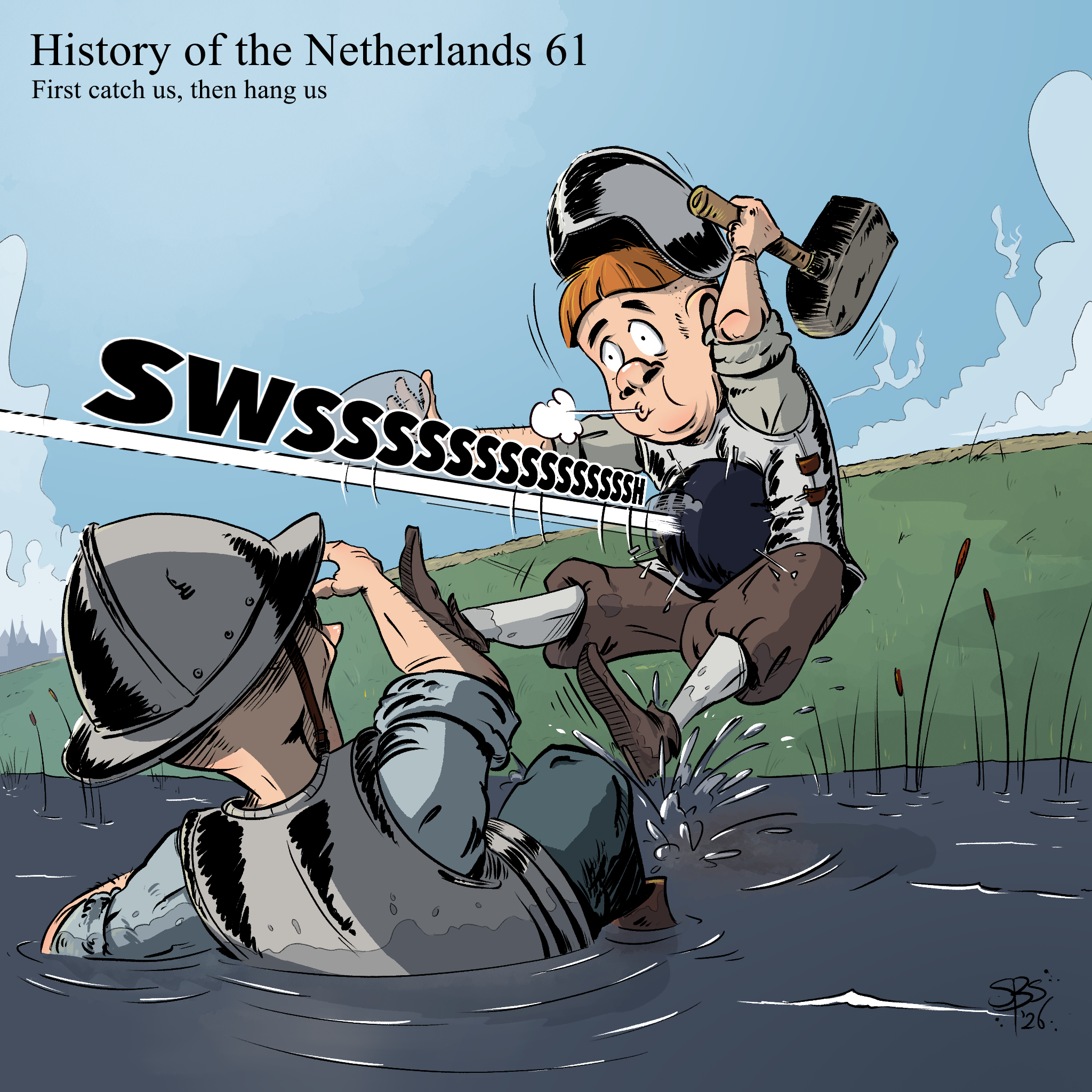
“First Catch Us, Then Hang Us” episode artwork by Steven Straatemans
Of the many political issues which loomed large over the Low Countries in the early 1500s, the ongoing war with Guelders was perhaps the most pressing of all. This conflict impacted all levels of society from the ruling princes and their courtiers to the regular citizenry who faced the brunt of marauding soldiers. Throughout this podcast, we have eagerly sought not to eschew the earnest engagement of unease that the Guelders situation evoked amongst the elevated echelons of the social hierarchy in Europe, given that it was essentially a conflict between Imperial and centralising rulers (Maximilian and his progeny) and a native born prince (Charles of Egmont) selling himself as a resistance hero, whose biggest ally in it all (the King of France) was the powerful arch-enemy of those same imperial rulers. Over the last few episodes, we have hopefully woven the narrative well enough that you know, by now, what a lot of the diplomatic discussion and debate would have looked like, as the Guelders situation took its place on the wider playing field on which European royalty was wrangling for power.
For the towns of Holland and Brabant, which bore the brunt of Guelderian raids, tensions ran high as money was poured into defense, with citizens made to train and purchase weapons and town armaments were either built or improved upon. Historian James P Ward gives a fantastic summary of what kind of situation Dutch towns and cities were looking at during the context of this war, as pertained to their defenses, “city defense was in the hands of the magistrates and the citizens themselves, but they were frequently warned and advised by the government about measures they needed to take. One of the dilemmas facing early sixteenth-century architects and fortress builders was expressed by Albrecht Dürer as the need to build a fortress strong enough to be held but not so strong that if it fell into the hands of the enemy by subterfuge, treachery, or otherwise it could not be recovered.” In the architecture of defenses, Ward goes on to argue that Dutch towns were transitioning from medieval design to a style better suited against contemporary arms, which would become known as trace italienne. One of the most striking examples of that in the Netherlands today is the town of Naarden, whose 17th century star-shaped fortifications are some of the best preserved in Europe.
The nature of the Guelders war meant that towns never knew if or when they would become embroiled in the violence, so they had best be ready for it. In The High and Puissant Princess Marguerite of Austria, our dear companion to recent episodes Marian Andrews wrote of the Guelders war, “it was no great war, in which the combatants might distinguish themselves by brilliant feats of arms; no very striking events, no decisive battle. It was simply a long, disastrous struggle, almost the nature of a civil-war between near neighbours, when we hear now of a little town being surprised, probably by treachery; now of a castle besieged and taken with cruel massacre; a convent burnt to the ground; or merely a company of merchants robbed by brigand “piétons” and murdered if they made resistance”. Different historians of the Guelders wars have been making different comparisons of it throughout history. Contemporary monks wrote of the horrors of it while, centuries later in 1937, it was described by Charles Oman merely as “narrow-fronted scuffles along the tops of dykes, or desperate attempts to cross difficult water-barriers” Unsurprisingly, after the Second World War Charles of Egmont was imagined as a determined leader who rallied his people against seemingly insurmountable odds, which itself is still more modest than the comparison to Achilles that is inscribed upon his burial monument. For what it’s worth, James Ward likens him more to Hannibal and has, himself, more recently compared the Guelders war in general to the wars in the Balkans in the 1990s. So it is not a simple event or series of events to pin down and was not a conflict full of large scale, set piece battles, but rather one defined by smaller-scale raids, lootings, kidnappings and hostage takings, which would have been miserable to live through for the regular citizenry of Holland, Brabant and Utrecht.
We have spent the last few episodes focusing on the high-level politics of the Low Countries as Margaret of Austria became regent following the death of her brother. In this episode, however, we want to take a more granular look at the Guelders war by zooming in on the events as they affected one city in particular, Amsterdam, during a roughly one year period from the end of 1507 until December 1508. Mainly, we want to develop a perspective of how people who were not dukes, bishops or princesses, but rather the regular Jans and Geertjes; citizens of a small but powerful town, whose lives were greatly impacted by the actions and decisions of those above them on the social hierarchy ladder of life that existed at the time.
We have been on imaginative journeys through Amsterdam before, once in the 1420s (Episode 22) and more recently (in Episode 53) as we explored the shipbuilding traditions that were, by then, well established. Well, we figured there is no harm in going back, some twenty years on from that most recent adventure, to see what has become of our caulker and how he may have experienced a tumultuous year in Amsterdam as the Guelders war suddenly erupted on the city’s doorsteps. Our account of this time is mostly based on the history of Amsterdam written by city historian Jan Wagenaar, published between 1760-67. Wagenaar was given unrestricted access to the city archives and this use of primary sources means that his account is full of the vivid details you are about to live through. So kick back, relax, and transport yourself back in time, to the early autumn of 1507…
Early measures against threats from Guelders
Your footsteps pound over the wooden planks that line the muddy path. The cold north-wind batters into your face and the sting in your old hands tells you that a storm’s not far away. As you turn towards the Warmoesstraat and step onto the stones cobbling the way, you can feel a flurry of anxiety amongst everyone there. That isn’t so unusual these days, not since July when unpaid Guelderian soldiers had started marauding through the lands of nearby Utrecht. The Amsterdam town council’s reaction to the threat of these troops had been severe, proclaiming that “no resident was to travel to Utrecht, on pain of forfeiting their citizenship rights, due to the depredations of the Guelderians”. This punishment meant losing the legal protections of the city, foregoing the freedom from tolls in Holland which Amsterdammers had enjoyed for over 200 years and disallowance from participating in the city’s guilds anymore.
Soon enough, that initial proclamation became stricter, turning into a general prohibition on anyone coming or going from Amsterdam. The order reads “no one might enter or leave the city without possessing a token from an official appointed by the city for this purpose, stationed at the home of the widow of the late Jacob Willemsz. in the Kerckstrate.” As you hurry up the street, you pass the Oude Kerk, where Warmoesstraat becomes Kerckstrate. As you walk past that building where those tokens are issued, you remember how all of these regulations had scuttled your hopes to travel to Amersfoort a few weeks ago. Your wife had been ill and in your desperation to help her recover, you wanted to make a pilgrimage to Amersfoort to pray to the miraculous statuette of Mary at the Church of Our Lady, which is said to have healing properties. This, you had had to forsake, as the official had not deemed your reason as worthy enough. You curse Charles of Egmont again under your breath as you remember how devastated you had been thinking your wife was going to die. Luckily, she has recovered regardless, which seems in itself a miracle. Your contempt for Egmont and his marauding brigands has not abated since.
The situation with Guelders has escalated further since then. At the end of August, on the eve of St Augustine’s day the damned Guelderians had burned down Bodegraven, a village south of Amsterdam and, now, some weeks later, the town council has issued an order that reads, "All residents capable of bearing arms to hold themselves ready to march out against the enemy at a moment's notice; for this, all tradesmen and artisans were to be paid a stuiver, and—should they actually march out—five stuivers per day." That includes you. You might be getting old, but you are still strong after years of manual labour hammering sphagnum into ships to waterproof them and you are definitely still able to bear arms. You struggle to fall asleep at night, as you are always on edge, waiting to hear the clattering of bells or the blaring of trumpets, calling you to fight against the enemy.
Even though you had come here from Flanders, back in your youth, Amsterdam has become home. Some years ago you had managed to become a poorter, a citizen, by marrying Trijntje, the daughter of a shipbuilder. Together, you started a family. You are no longer just an inwoner - a resident -, but a member of the city; a part of its varied and colourful fabric. You received the right to join a guild, not that there is one for caulkers, and you could - and did - move into a nicer part of town. It gave you other rights, most notably that to not have to pay tolls for goods shipped in Holland, which has allowed you to expand your business into moving specialised ship parts around to different shipyards, giving you a comfortable, yet physical, working life. Your children are learning your skills and the business and they wo;; be able to take it over in the future. All things considered, Amsterdam and her harbour has treated you very well over the last 15 years or so and you will eagerly do your duty to defend them. But for now, it’s wharfie time lol, and you trod on into the wind, heading out a gate and towards the Lastage, an industrial area to the east of the city just outside the stone walls, where you’ve got caulking to do.
Order to remove all wood from the Lastage and then to dismantle it completely
The much dreaded call to arms hasn’t come and life has continued on with at least a semblance of normalcy. The dark, cold months of winter set in. The hostilities between Holland and Guelders has been ongoing for a few years now and the steps the city council has chosen to take in the face of this war over the past few winters has made life increasingly difficult for those of you who work in the Lastage. In the winter months, up to 200 ships would typically lay moored in the Oude Waal, the harbour on the north side of the Lastage, so they could be repaired, caulked and refitted for their journeys in the spring and summer. To do that work, all sorts of raw material is needed, like planks, pitch, tar, hemp and firewood, all of which is highly flammable. When winter sets in, the water in the harbour was wont to freeze - creating a vulnerability in the city’s defenses. Enemy troops could simply cross the ice into the Lastage and sneak up to the city walls. From there they could quite easily put the city to siege, or even burn the whole Lastage to the ground, which would be extremely hazardous to the city proper. Amsterdam has walls around its east, south and west sides, but the north side of the town, which faces the water, is more open (being the primary access to the waterways). It is less defendable. As such, for the previous three years, the city council has maintained the order that in the winter months the citizens who live nearby the IJ, Amsterdam’s harbour, are required to build fencing in front of their houses and woodyards. This winter, however, in addition to erecting fencing, no pitch, tar, wood, or ship tackles are allowed to be left in the Lastage. Countless shipworkers and masters groan. How would anyone be able to do their winter work?
Along with the city’s order “to remove all timber from the timber yards situated between Screyehoeck and St. Olof's Gate”, a boundary line is drawn that runs from the Paul’s brothers monastery, near the Holy Way to Bethanies Almshouse near the St Anthonispoort. It is decided that everything on the north-east side of the line is to be demolished. The reason that the city is demolishing this section is to ensure a clear cannon shot from that part of the city walls. With all the run-to and ramshackle buildings there, cannon is useless against a stealthy attacking army that might think to use the buildings in the Lastage as cover. This affair, you realise, is going to be extremely costly for your business. With civic duty in mind, however, you go and volunteer your services to rip all the wooden structures in that part of the Lastage apart, which is a far cry from your usual work and custom there of rather trying to keep wood together.
Several weeks later, now in the one thousand, five hundred and eighth year of our Lord, you learn that the authorities in towns and cities along the coast of the Zuiderzee have collectively ordered “that no one was to sail eastward or westward from that sea until further public permission was granted”. You and other shippers moan once more. Goods sit, unshipped; men have to be paid. Winter passes drearily and hunger lingers with many. The sun eventually gets stronger. The birds in the canals swoon and fight, but the tension mounts in everybody. Much of your business is now stifled, since you can no longer move goods to the eastern regions, but you still have enough orders to fill going south to Dordrecht on the doorvaert binnen duinen. A lot of the shipyard work has ground to a halt, since the removal of wood from the timber yards and rumours abound that the government is going to move the shipyards all together.
You and everybody else in Amsterdam wonder how it is possible that this disastrous war with Guelders has not yet come to an end. In April, the States General is convened in Ghent and hopes are raised that perhaps, there, a solution might be found to reduce the burden which everybody in Holland and Brabant is bearing. The Lord Maximilian has requested that the states grant him money so that he can pay for 10 thousand more troops and two thousand more cavalry, which will certainly be enough to keep Holland and Brabant safe from Charles of Egmont. Unfortunately, word returns that the States General unanimously declined to give more money to pay for the war, deeming it to be an issue for the house of Burgundy, not one in the general interests of the lands. You are incensed though, as you know that the house of Burgundy isn’t the one paying for this war, but it is yourself, and your fellow workers and shippers in the towns of Holland, whose lives have been ground to a halt because of it.
Word comes that Guelders troops have captured Muiden and Weesp.
On the 23rd day of May, word arrives in Amsterdam that your worst fears have been realised and that two important defensive locations to the east, the town of Weesp and the nearby castle at Muiden, have been captured by Charles of Egmont and his Guelderian forces. The shock is palpable across the town and the threat to Amsterdam could not be greater. The enemy is but one town away and in possession of a castle! From there, the troops from Guelders can easily make their way to the Diemerzeedijk, a raised road that leads through the impassable, boggy morass. It is the only accessible land route from the south and east of Amsterdam and a path from Muiden straight towards the Lastage and the vulnerable side of the town.
The tension and excitement in the city surges. Everywhere you look, everybody is in a hurry. That day, the city orders that all workers are obliged to go to the Lastage and dismantle all wooden structures, meaning: everything. All goods have to be brought within the protection of the walls and all ships have to be moved to new moorings by the Nieuwe Waal, on the other side of the town. You and your grown children trudge on down and spend the whole day uncoupling beams and dragging away sacks and barrels, and helping skippers with their vessels. Amongst the business owners there is heavy discussion and discontent and someone mentions a petition demanding compensation from the city. You are one of the few actual citizens amongst them and the small group there looks at you for your opinion. You do feel aggrieved that the city is just trampling over your business, encumbering your rights to commerce and trade. You also reflect that, even after a decade, you still surprise yourself by the sense of entitlement that being an Amsterdammer has given you. At the end of the day, everything which is left over is set ablaze and the smoke from the remnants of the Lastage leaves an acrid pall over the city.
A priest arrives demanding Amsterdam surrender to Charles of Egmont.
The next morning, word trickles across the city that a priest has arrived at the St Anthony’s Gate, so you make your way down there, along with half the city it would seem. The priest is bearing a message to the city of Amsterdam from Charles of Egmont, who he calls “the true Duke of Guelders”. An angry murmuring spreads throughout the crowd which is gathered to listen to what this priest has to say. The Amsterdammers couldn’t give a damn about whether Charles of Egmont, or Emperor Maximilian, or the kid of the late King Philip, calls themselves the Duke of Guelders. What everyone cares about is that this is a terrible affair for everyone’s business and must cease. The priest nervously clears his throat and continues, “Duke Charles demands that the town of Amsterdam surrenders peacefully to him and requires that the town council acknowledges him as their Lord”. There is jeering and whistling from the crowd as you see the mayors quickly conferring with each other before replying “We swore our allegiance to King Philip and we shall remain loyal to his children. And as you can see the citizenry is not yet in such a predicament that they should wish to change lords”.
The priest looks flummoxed at this response, before shaking his head and saying “very well, then you should give your response in writing so I can deliver it to Duke Charles.” Once more the mayors lean in to discuss this quietly between themselves, before the most rotund one of them all steps forward and says “I didn’t see your message from that scoundrel in writing and we’re certainly not going to waste our paper on him, so you can kindly advise your lord that he can firmly place his request directly up his…”. You don’t quite catch the last word as the erupting cheers from the crowd nearest drown it out, but the mood of the onlookers is certainly buoyed as they jeer the priest who trudges dejectedly out of the St Anthonis gate back towards Weesp.
The excitement of the morning gives extra drive to the citizens of Amsterdam to make sure they are truly prepared for the enemy army which is surely just hours away from besieging their walls. The city council issues orders that all buildings outside the St Anthonis gate are to be dismantled, which include the beautiful target range of the Archer’s Guild. The trees which the archers would hang their targets on are to be chopped down to make sure that the enemy couldn’t use them as cover and the Shoemakers Guild is engaged to carry all the fallen trees inside the gates. Much like the nearby Lastage, these remnants, too, are burned to the ground. There are also further proclamations, that nobody should be taking any gold or silver outside of the city and that all merchants from Amsterdam, who had gone to markets in Antwerp, are to return as soon as possible. Messengers are sent from the city; The time for battle is fast approaching.
The first attack Guelders attack on May 25, 1508
The next morning you, along with every other able bodied man, gather to receive orders from the city’s militia. You leave through Anthonispoort and begin to march along the road on the dike towards Diemen. After about 20 minutes you see the waters of het IJ in the distance, glistening in the early morning sun. You cannot mistake the smoke that rises from the horizon as being anything other than a harbinger of destruction and doom. It tells you that Charles of Egmont has taken the village of Diemen. Diemen is on fire. Everyone puts an extra step in their stride when they see the distant sight, as if you all make a silent agreement to get there quicker. The body of men squeezes onto the dijk that runs all the way to Muiden, with the waters of the IJ lapping the left and the bog surrounding the Diemermeer lake to the right.
At the narrowest part of the dijk, at a hamlet called Ypesloot, a temporary fort has been hastily constructed. There, you are told, you Amsterdammers will halt the Guelderians. As you arrive at the fort, you scan the low lying marshy field, called the paapenveld and then the adjacent waters of the Diemermeer. You see several ships anchored there, part of a defensive ring. The crowd of men gathered on your side is not very organised and many, like you, start milling aimlessly around, looking back towards the city… planning an escape route. A militia captain in glistening attire rides up to you on a horse, points down and makes a grand, sweeping motion that snares you and a few others in your vicinity. The captain points down to the water and tells you all to get on a boat, indicating a series of small tenders bobbing near the soggy bank. You are rowed out to float within a barricade, protecting the fortification alongside other small boats full of men and the larger ships. You are armed with a wooden pike and protected by a steel helmet and breastplate that you took as payment many years ago. It fit you better back then and, as you feel its pinch, you can also feel your heart pounding against it.
When the enemy arrives you hear them before you see them. They come streaming, screaming and shouting across the paapenveld, the ground that runs adjacent to the dijk. Some take cover in and behind the little huts dotted along the way, while a large number head straight for the nearest ship docked in the Diemermeer side, not far from where your boat is. Quickly you are rowed forward and you are told to get ready. You are within ear-shot of the Guelderian fighters now and a man next to you starts shouting insults at them. They stand on the dijk and start throwing things at you all. Missiles sail over your head but a man on the boat next to you gets hit. “Water dogs!” shouts a Guelderian and others pick up the appellate and howl it out themselves, derisively spitting towards you and gesturing menacingly, as if indicating that you are soon to hang. “Water dogs!” Water dogs!” Your blood is up and the hatred you feel in your guts for these Guelderian animals knows no bounds. You want to humiliate them. “First catch us…” you shout “then hang us!” The men around you howl in laughter, prodding the fury of the attacking Guelderian force. It seeps out as a chant. “First catch us…then hang us!” “First catch us…then hang us!”
The Guelderian charge towards the ship comes as you are scrambling from the boat up on to the dijk and everything becomes a vague blur. A man comes screaming towards you, some sort of hammer held aloft. You watch his arm extend out, ready to swing the hammer to strike thunder upon your head. You are not ready for this. There is nothing you can do except close your eyes and pray. This is how you die.
Thunder is what comes; just not delivered to your head. A momentous clap from the heavens causes everybody to stop. You look at youur assailant, not a few feet away from you, and see his eyes widen for the briefest moment before a cannonball smashes into his side, sending him flying from the dijk. Your ships are firing at the Guelderians. The bombardment rallies the Amsterdam contingent, who push forward past the fortification and into the stalled Guelderian attack. The barking of a militia man spurs you down the dijk. The Guelderians are faltering and, in many cases, hastening a retreat. You hear shouts that one of the huts nearby has Charles of Egmont himself bunkered up in it. The cannons aim that way and the walls are riddled with holes. With a few bodies strewn across the earth, the enemy enacts a full retreat, dispersing in the direction of Weesp. Cheers go up amongst the Amsterdam fighters and you take a deep breath, for what feels like your first one in hours. You return to the city that afternoon and sleep more soundly than you have in months.
The second battle on Diemerzeedijk on June 24, 1508
You and your fellows Amsterdammers had successfully repulsed the Guelderians in this first confrontation, but the enemy armies are still safely ensconced in the towns of Weesp and Muiden. Over the next few weeks, you are placed in a rotation whereby you have to either take guard at the fortification at Ypesloot, or in the vessels in the water on either side of it. You spend many nights over the following weeks at the fortification, doing your best to fight the urge to sleep, peering through the darkness at the water faintly reflecting the light of the stars, listening out for the slightest unusual sound, any range of which might signal the enemy’s approach. You pass the time by speaking to the others on guard about their lives.
One night, a Frisian soldier complains in his strange accent that the war between Maximilian and Charles of Egmont has cost his family their livelihood as their ships cannot sail on the Zuiderzee anymore. He mutters under his breathe that both of these pompous men were as bad as each other and that he couldn’t care less who wins this war, as long as their ships can get back out on the water as soon as possible. The commander of the fortification, Gerard van Mierop, walks in as the Frisian is making these comments and abruptly tells him his duties are done for the night. As the Frisian soldier departs, van Mierop looks you in the eye and says “Never once seen a smile from that chap. Not sure his heart is in it. Frisians, they’re always so gruff! Wot!” He laughs jovially and you peer back into his eyes. As you do, something strange happens. You blink and suddenly feel as though you are in a dream. Everything around you is foggy, like a mist has risen from the earth. Yet van Mierop’s face remains clear, his mouth still moving. He is speaking, but though his mouth makes the shapes, it is not his voice that you hear. The voice you hear is coming from a distance, a vast distance you feel, one that transcends not just space… but… time, like it is coming to you from a different…a different world. You watch the mouth and try to listen to what the voice is saying, but what you hear is indecipherable. It’s a different language. Yet… yet… it is familiar: “ding, ding, ding” it is saying, then it stops. There is a pause, before you hear the following “Aaaaand I bet you didn’t know that was Dutch! The modern English word Gruff comes from the Dutch word grof, meaning coarse or thick. Amazing, right?!! But don’t get confused by the fact that this character is actually speaking middle Dutch and has no idea what ‘Dutch’ might mean. Don’t think aboooouuuut iiiiiiit….” The voice trails off. You’re very puzzled by all this and wish you could have understood what the voice was saying. You blink again and the hazy state ceases, van Mierop has walked away to tend to other affairs. The world appears as normal. A few days later you come to learn that the Frisian soldier has been discharged from further service entirely, having been deemed as not loyal enough to the cause.
The short night of the 24th of June is exceptionally dark for midsummer. The waning crescent moon casts scant light as you sit on a ship, gently bobbing around in the waters of the Diemermeer lake. You listen to the sound of the waves lapping the boats and of horses grazing in the darkness on the dike. Their intermittent whinnies and the sound of their soft hooves in the grass has been an unexpectedly comforting companion to you and your fellow guards during these long nights on duty. It is difficult to see through the inky blackness, but you think you see a horse slowly walking towards the fortification in search of fresh grass. Suddenly, a blood curdling scream comes echoing out across the water, followed by another. “What was that?!” one of your companions on board asks, with panic in his voice. The answer became obvious as the sound of battle broke out on the dike. The Guelderians are attacking! The commander of your ship hastily orders you all to prepare to fire at the first sign of any enemy who might approach us by water. The soldiers at the cannons ask whether they should open fire on the dike, but the commander tells them not to, since shooting blindly could cause more harm than good. You feel helpless as the sound of battle rages on throughout the night.
Dawn breaks early and the gloom of twilight is pierced by the sun’s golden rays, you all gaze intently at the fortification, trying to see whether or not it has been captured by the Guelderians. Soldiers are fighting on the side of the fortification which faces Amsterdam. Are they Amsterdammers or are they the enemy? A few small boats lie on the edge of the dike and your stomach sinks. The enemy must have silently rowed past you through the darkness and attacked the fortification at its most vulnerable side. As feelings of guilt swirl around you for failing to spot the enemy, you see a head stick up above the parapet. It is Gerard van Mierop, the commander, who yells at the top of his lungs “BURGUNDY! BURGUNDY!”. The fort has not been captured! Everybody on your ship swiftly swings into action and the ships immediately fire at the soldiers on the dike. As the cannons roar, the soldiers on the dike scramble for cover. Some try to run to the boats with which they had rowed to the dike, but quickly realise that this would just bring them into range of your guns. Chaos ensues and the soldiers from Guelder turn and run, sprinting along the dike in the direction of Amsterdam. Cheers ring out from the fort and the ships.
A few hours later, word comes from Amsterdam that the Guelderian soldiers had been intercepted by Reinier Mosterd, who at first light had been leading a group of citizens out of the city towards the fortification to replace those on duty. They had found the exhausted soldiers from Guelders hiding in ditches and long grass along the route, where they immediately surrendered. The enemy have been taken back to Amsterdam as prisoners of war, except for one man, who had bravely but futilely, attempted to attack the Amsterdammers from his hiding place with a pike, only to be quickly killed himself. You learn with horror that it was that Frisian soldier you had been stationed with at the fortification, who had been discharged from service. He had defected to the enemy and provided them with all the information they had needed to launch this surprise attack. Despite this treachery, you and the other Amsterdammers have managed to halt the Guelderians at Ypesloot for the second time in a month.
Weesp put to siege and Maximilian visits
The mood within the city is buoyed when reports arrive that Charles of Egmont has departed from Weesp and returned eastwards towards Guelders. With the inspirational leader of the enemy no longer present, the imminent threat of another attack on Amsterdam seems to have passed. The towns of Weesp and the castle at Muiden remain under the command of his soldiers, however, and it is decided that the best course of action now is to go on the offensive. From July, Weesp is put to siege by an army led by Floris van Egmond, the Count of Buren, who is helped by a force from Amsterdam led by Reinier Mosterd. You remain in the city, eager to get to work rebuilding your business. In August, 1508, word arrives in Amsterdam that Emperor Maximilian is on his way from Leiden to personally lead the besiegement of Weesp. On the 20th of August, you notice a commotion and are somewhat bemused to see that all the nuns in a few nearby convents are standing at the windows, looking impatiently out on the street. You ask a bystander what’s going on and he replies that Emperor Maximilian has ordered the nuns to greet him as he enters the city. A herald’s trumpet signals that the Emperor is approaching. You see the emperor on horseback, in splendid armour, waving at the crowd. Maximilian enters the Convent of Bethany, to offer them money and wine so that they might pray to the prosperity of his realm. That night, like every other night, you too pray, hoping for divine intervention to return prosperity to your household.
A devastating flood hits Holland
But the siege of Weesp continues as the summer of 1508 fades into autumn. On the 15th of October, the eve of St Gall Day, a violent storm rages over Holland. You sit in your house, listening to the wind rattling the shutters on your windows and the rain clattering against the roof. Bells begin to ring out across the city, creating an ominous cacophony, warning that some kind of disaster is unfolding. A few minutes later, there is a banging at your door and you open it, to find your oldest son and his wife, their eyes wide with fear and their clothes soaked. Through panting breaths your son explains that the sea has risen so much that it has spilled over the dike and come pouring into the neighbourhood in which they lived. Their house had begun to fill with water so they had escaped as quickly as possible, with no time to try to save any of their possessions. You offer them dry clothes and a spot next to the fire and spend the night praying together as the storm unleashes its fury.
The next day, you walk to your son’s neighbourhood to discover that his house, along with so many others, is uninhabitable. The storm has done great damage to the city and the surrounding countryside, with countless animals and people having drowned in the salt water. A section of the dike between Amsterdam and Muiden has actually collapsed in the storm, meaning that one could now sail over the meadows towards Weesp. A few days later, you discover that the people of Waterland, just north of Amsterdam, have a plan to liberate Weesp by boat, but their proposal is rejected as peace negotiations are apparently already underway to end the war with Guelders.
The Peace of Cambrai brings hostilities to an end
On the 7th of December, 1508, an order is pronounced from the Amsterdam town council to hold a solemn procession to seek peace and tranquility. You, your wife and your sons join in with the rest of the citizenry as you walk from De Plaetse, in the centre of the town, through the cobbled streets, past the recently inundated houses which are starting to be repaired, along the canals which this year have been so eerily silent as the war has ground the business of the city to a halt. You think about the destruction of the Lastage, about how much rebuilding must be done there, about your fellow citizens who were killed in the Guelderian sneak attack on the fort and about how close you came to having your skull cracked open in the first attack. Despite your best efforts to remain solemn, you can’t help but weep at the overwhelming sense of helplessness in the face of it all. But a few days later word arrives in Amsterdam that the regent, Lady Margaret, has reached an agreement with the Archbishop of Rouen at Cambrai which promises peace with Guelders. By the terms of the agreement, Charles of Egmont’s forces must leave Weesp and the Castle of Muiden within 14 days. The news is greeted by cheers. The constant feeling of dread which has accompanied you, sitting heavy on your shoulders for more than a year, suddenly feels lighter…is lifting. Your nightly prayers for peace have finally been answered. It has been a tumultuous and dark year for you and for Amsterdam, but as the year 1508 draws to a conclusion the future appears to be a little bit brighter.
Sources used:
Amsterdam, in zyne opkomst, aanwas, geschiedenissen, voorregten, koophandel, gebouwen, kerkenstaat, schoolen, schutterye, gilden en regeeringe by Jan Wagenaar
“Security and Insecurity, Spies and Informers in Holland During the Guelders War (1506–1515)” by James P. Ward
The high and puissant princess Marguerite of Austria, princess dowager of Spain, duchess dowager of Savoy, regent of the Netherlands by Marian Andrews (pen-name Christopher Hare)
“De Opkomst Der Amsterdamse Haven” by W. H. M. De Fremery in Jaarboek Amstelodamum 22 (1925), 23-110.
“Amsterdam’s zeehaven in beweging: de Lastage” by Theo Bakker https://www.theobakker.net/pdf/haven.pdf
Geschiedenis van het Nederlandsche volk. Deel 1 by P. J. Blok
“Historisch hout in Amsterdamse monumenten” by Gabri van Tussenbroek
“Een Licht op Diemen in de ‘Enqueste’ van 1494 en de ‘Informacie’ van 1514” by Jaap Haag in Historische Kring Diemen Jaargang 30 - Nummer 1 - 2020.
De Divisiekroniek van 1517 Uitgave van het Bourgondische-Habsburgse deel (divisie 29-32), edited by Karin Tilmans, Amsterdam 2003.